

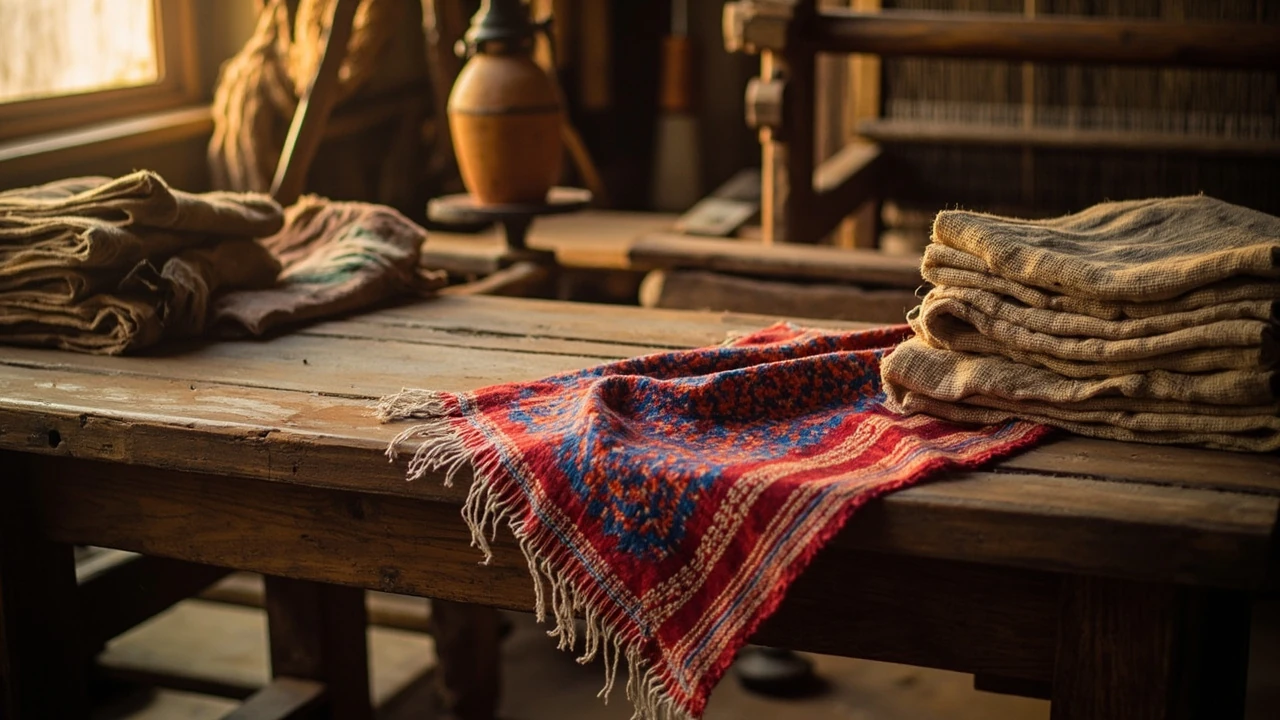
What is krama, and why does it matter?
A traveler looking for a meaningful souvenir in Cambodia may encounter rows of checked scarves, necklaces, wall hangings, belts, and folded cloths that all appear to be variations of the same item. The Cambodian word krama covers all of them, but it is more than a generic scarf. It is a versatile traditional textile, a symbol of Cambodian identity, and an object shaped by weaving, daily use, ceremony, historical memory, and the work of local communities.
The name is commonly pronounced krah-MAH. A traditional krama may be worn around the neck, over the head, across the lower body, or as a scarf, bandanna, belt, blanket, or face covering. Its rectangular shape allows one person to adapt it to different needs, while checked and gingham patterns have become especially recognizable. Although modern versions are sold in many colors and decorative finishes, the classic red-and-blue or red-and-white checked designs remain closely associated with Cambodia.
That distinction matters for several reasons. First, a traveler is more likely to use the item well when understands its range of functions. Second, asking sensible questions about materials, weaving, and origin can prevent disappointment at the market. Third, recognizing the garment’s cultural history helps a visitor avoid reducing it to a costume accessory. Finally, understanding how krama is produced allows buyers to support weaving communities without assuming that every checked scarf was made by hand.
| Feature | What a traveler will commonly find | Why it matters |
|---|---|---|
| Shape | A long, rectangular piece of woven cloth | Its generous shape allows different uses without cutting or special equipment |
| Pattern | Gingham checks, solid colors, stripes, and decorative designs | Checked patterns are traditional and recognizable, but modern variations also exist |
| Material | Commonly cotton or cotton-blend fabric; some examples use other fibers | Ask for the actual composition rather than assuming every soft cloth is pure cotton |
| Production | Handwoven on traditional looms or made with modern textile machinery | Production method affects price, texture, consistency, and the story attached to the item |
| Use | Scarf, head covering, face covering, belt, lower garment, blanket, or decoration | The same basic form can serve ordinary, ceremonial, or commemorative purposes |
The central point is simple: krama is best understood as a cultural textile with many uses, not as a single souvenir product with one correct pattern or function.
Why krama matters in Cambodian history and culture
Krama is widely recognized as a national symbol of Cambodia, but its deeper significance comes from how closely it connects everyday life with historical continuity. Traditional production involves handloom weaving, dyeing, and preparation of yarn. Looms known as kei or kei dombhang are associated with this craft tradition, and weaving knowledge has passed between generations, particularly among women in producing communities.
The history of the cloth extends far beyond the modern souvenir market. Evidence discussed in accounts of krama suggests that krama-like garments may have existed during the Pre-Angkor period, roughly between the first and fifth centuries CE. Archaeological finds at Angkor Borei include images of Hindu deities wearing a kben, a simpler hip wrapper that could resemble a large krama in form. These references help explain why krama is not associated with only one narrow religious identity, even though textiles of this kind can also appear in ceremonial contexts.
Another historical marker is the account of the Chinese envoy Zhou Daguan, who visited Angkor around 1296–1297 and described local textile production. According to the supplied historical context, people in Angkor Thom did not then raise silkworms or sew in the way familiar to many other societies, but they did weave cotton cloth from kapok. Their basic hip wrappers were considered larger than a typical krama. This history suggests a long tradition of locally produced woven cloth, though it should not be treated as proof that every modern krama has an identical ancient predecessor.
The familiar checked pattern also carries difficult modern associations. Red-and-white gingham krama scarves were worn by many Khmer Rouge fighters during the rule of Pol Pot. Consequently, some Cambodians may decline a red-and-white checked krama or prefer blue-and-white or another color because of that history. This reaction varies by person and context; it is not a universal rule for every Cambodian. It does, however, show why the colors of a krama can carry emotional meaning far beyond their decorative effect.
Krama also appears at life events. The textile has been used to wrap ritual offerings during religious ceremonies and celebrations, and it is associated with greetings, respect, and important stages of life. Its symbolism therefore develops through use rather than remaining locked inside a museum display. A practical description of the cloth should hold these everyday, spiritual, and historical meanings together without reducing the garment to one story.
One useful way to avoid oversimplification is to think about Cambodian culture as a collection of living communities and traditions rather than a single uniform identity. Our overview of Sri Lanka Religion Is Much More Diverse Than It First Looks makes a comparable point about looking beyond a first impression of a country. The lesson transfers well to Cambodia: a visitor who recognizes personal preference, regional context, and community variation will interpret a krama more accurately than one who assumes there is a single Cambodian response to every color or use.
For travelers, this history creates a practical reason to handle the garment respectfully. A krama can be cheerful, practical, patriotic, sacred, or uncomfortable for someone nearby, depending on its use and associations. Asking before wearing a ceremonial item or using a politically charged pattern in a sensitive setting demonstrates attentiveness without turning every interaction into a solemn ritual.
How is krama used in everyday life and special occasions?
The versatility of krama is one of its most useful characteristics for a traveler to understand. Its rectangular shape allows it to cover different parts of the body or perform different jobs without permanent alteration. A cloth bought for one purpose may become useful in several others, which makes it more than a decorative object.
- As a scarf: It can be draped around the neck or over one shoulder, either loosely or tied.
- As a head covering: A traveler may fold or wrap it to protect the head from sun or dust.
- As a face covering: The cloth can cover the nose and mouth in dusty or bright conditions.
- As a belt or waist wrap: It can secure clothing or function as a light lower garment when properly arranged.
- As a light blanket: Larger pieces can provide warmth, shade, or a surface covering.
- As decorative fabric: The cloth may appear in wall art, room textiles, clothing, or festive decoration.
- For ritual offerings: A clean krama may be used to wrap or present offerings during religious ceremonies and celebrations.
These uses do not all belong to the same context. A scarf used for sun protection and a cloth used to wrap an offering may be structurally similar but socially different. Travelers should therefore watch what people around them are doing with the garment rather than assuming every visible use is interchangeable.
Color and pattern can also guide the choice for a particular activity. Red-and-blue checked krama are often treated as a classic presentation, while blue-and-white, solid-color, striped, and more decorative versions are readily available. For a commemorative gift or a personal everyday scarf, the buyer can focus on color preference and practicality. For a ceremonial setting, the host, community, or religious leader is the proper person to advise on what is appropriate.
| Intended use | Useful qualities to consider | Traveler’s next question |
|---|---|---|
| Everyday scarf | Softness, secure drape, comfortable weight, and a pattern that suits repeated use | Will the cloth stay comfortable in heat and humidity? |
| Sun or dust protection | Coverage, opacity, light weight, and breathability | Is it large enough to fold and secure without restricting movement? |
| Travel blanket | Greater width, softer hand, and secure edges | Will it pack compactly and dry quickly after use? |
| Decorative display | Color, pattern, workmanship, and overall finish | Does the seller know how the piece was made? |
| Ceremonial gift | Cleanliness, appropriate color, and accepted presentation | Should the item be offered directly or given to someone coordinating the ceremony? |
Because krama can be worn in so many ways, a new owner does not have to select one “correct” use at the moment of purchase. The cloth may begin as a wall hanging and later become a neck scarf, or begin as a travel accessory and later be repurposed. Its open-ended design is part of its practicality.
At the same time, avoid turning every use into a performance. Pulling a krama over the head and posing for photographs can reduce a culturally meaningful textile to a prop. The most considerate approach is functional: wear it when it serves a purpose, observe the setting, and ask if there is any doubt about how it should be handled.
How to choose a krama for travel
A good travel choice balances usefulness, personal taste, and production method. The most attractive color is not necessarily the most practical one, and the most expensive piece is not automatically the one made by a named craft community. Begin by deciding how the cloth will be used, then examine its material and construction.
- Decide the primary use. A scarf, sun cover, wall hanging, and gift require different qualities. Smaller pieces may suit neck or head wear, while larger cloths are more versatile as wraps or decorative textiles.
- Confirm the fiber content. Many tourist-market kramas are cotton, but sellers may offer blends or other materials. Ask directly what the cloth is made from, especially if softness, weight, or care requirements matter.
- Ask about the weaving method. A buyer should be able to distinguish handwoven production from machine-made cloth. Handwoven pieces may show small variations that are part of the craft rather than defects.
- Examine both sides and the edges. Look at how the fabric feels, whether the weave is even, and whether the edges are finished securely. Turn the piece over; a well-made textile should present a coherent surface on both sides.
- Check color against personal preference. Remember that familiar checked colors can carry historical associations. If giving the cloth to a specific person, consider whether color has personal meaning for them.
- Choose a size you can actually use. A large krama offers more options but takes more luggage space. A compact one may be better for a carry-on or a day trip.
Machine weaving and hand weaving both have legitimate places in the market. The issue is accurate labeling. Handwoven work may be slower to produce and can contain subtle irregularities in tension, alignment, or color. Machine-made cloth may offer uniform dimensions and a lower price. Neither characteristic alone proves anything about authenticity, so the practical approach is to compare the textile in hand and ask clear questions.
Dye quality is another useful point of comparison. Run a clean, slightly damp white cloth over the surface, but do not wet a finished textile without permission, especially if it is displayed as an artwork. Rubbing can sometimes reveal excess surface dye, while colorfastness also depends on the fiber and the dyes used. Natural or lower-impact dyes should not be advertised based on a color alone. If a seller makes a specific claim about the dye process, it is reasonable to ask where the information comes from.
Pattern should be considered as a combination of tradition and personal taste. Traditional checked designs are strongly associated with the Cambodian krama, but they are not the only designs available. A traveler who wants a versatile scarf may prefer a subtle checked pattern; someone furnishing a room may select a bolder composition. The most satisfying choice is one that works in ordinary use and does not depend on a claimed “authentic” status that the seller cannot explain.
Budget also deserves a practical conversation. Prices vary with size, fiber, weaving method, design, and seller, so a single fixed figure would be misleading. Rather than assuming that the highest price guarantees a village-made textile or that the lowest price indicates poor quality, compare the physical item and the information available about it. Current market prices should always be confirmed in person, and no bargain should be accepted without inspecting the individual cloth.
How to buy a krama and support the people behind it
Buying directly from a craft community can provide a stronger connection between the traveler and the textile, but it is not the only responsible option. Markets, specialty stores, cooperatives, and online sellers may all offer krama. The most useful distinction is not simply “local” versus “non-local”; it is whether the seller can explain who made the item, how it was made, and where it came from.
For general background on the Cambodian textile, this overview of the cloth and its documented uses provides a useful starting point. The deeper reason to learn about krama, however, is that a commercial label alone does not tell a visitor what the textile means. A cloth bought as a quick souvenir and a cloth made by a skilled craft community can share a basic form while carrying very different stories.
For a handwoven krama, useful questions include whether the maker used a traditional loom, where the weaving took place, and whether the piece was made by an individual or a group. If natural dyes are claimed, ask which materials produced the color rather than accepting the phrase without explanation. If the textile belongs to a named collection, look for information about the community and the production process. A thoughtful seller should welcome questions that demonstrate genuine interest.
- Ask who made it: Request the name of the weaver, cooperative, or community when that information is available.
- Ask how it was made: Clarify whether the cloth was woven by hand or with machinery.
- Ask about the fiber: Confirm the main material and any blend rather than relying on touch alone.
- Ask about the dyes: Learn whether a natural-dye claim applies to the entire cloth or only part of the color.
- Inspect the whole piece: Check the surface, reverse, edges, dimensions, and any repairs before paying.
- Keep the receipt: A purchase record helps with an exchange, a damaged-baggage claim, or later questions about care.
Community-based production has been especially important for keeping weaving skills active. The supplied cultural context describes women playing a central role in preparing yarn and weaving, while men may participate in activities such as planting cotton and sourcing natural dyes. It also notes the continuing work of producer groups and educational associations in preserving the tradition. This should not be reduced to a romantic claim that every tourist purchase directly supports a village, but it does show why purchasing from producers or transparent organizations can be more meaningful than buying an anonymous item whose production method is unknown.
Be cautious with sweeping labels. Terms such as “vintage,” “antique,” “tribal,” or “made by villagers” require context. A textile may be old without being an antique in the strict sense, and a modern commercial piece may still use traditional weaving or design motifs. Good buying practice is straightforward: ask for the item’s history, keep the seller’s answer separate from the label on the package, and rely on specific information rather than a romantic word.
Price negotiation can also be misunderstood. Some sellers welcome discussion, while others price items consistently. The traveler does not need to turn a purchase into a contest. Ask about the price, compare quality, and negotiate only when the setting and seller make it appropriate. A respectful exchange protects both the buyer and the broader reputation of visiting craft markets.
For travelers comparing cultural experiences across regions, our feature on South Japan Feels Like Several Different Countries Packed Together offers a useful reminder that neighboring areas and communities may preserve very different textures and traditions. The same principle applies to Cambodian textiles: a single checkered cloth may connect to shared national identity while individual communities add their own materials, techniques, and stories.
How to wear a krama respectfully
Wearing krama can be straightforward, but respect begins with noticing the setting. A scarf around the neck at a casual meal, a folded cloth protecting the sun during a walk, and a textile handled during a religious ceremony are not equivalent situations. The first question should not be “What does this look like?” but “What is appropriate here?”
When wearing one as an ordinary scarf or sun cover, use the same care you would apply to any borrowed cultural item. Secure it so it does not obstruct movement, keep it clean, and avoid placing it on the ground. If a host provides a krama for a specific activity, follow their instructions about where and how to wear it. When uncertain, a simple question is better than guessing.
Color sensitivity deserves particular care. The historical use of red-and-white checked krama during the Khmer Rouge period means that some individuals or communities may avoid that combination. Others may associate red-and-blue checked krama with national pride and wear it without hesitation. There is no universal preference. The useful response is to let the wearer choose when giving a gift and to avoid telling another person that one pattern is always festive or always offensive.
Photography needs the same context. If a religious or community practice is unfolding, taking part as an observer may require permission, especially if a krama is part of the activity. Do not handle ceremonial objects, interrupt participants, or stage a photograph that turns a meaningful object into a novelty. Ask before photographing a person, and follow local instructions at sites where photography is restricted.
Buyers also should resist the idea that using a traditional textile makes them culturally authentic. Wearing krama can express appreciation, but one purchased object cannot stand for an entire culture or a person’s relationship to Cambodian history. The more grounded approach is to learn what the item is, name its origin accurately, and separate admiration from understanding.
Be particularly careful when comparing garments or using them as a visual stereotype. The krama has roles in martial arts and in the history of conflict, but those associations should be discussed accurately rather than dramatized for entertainment. Its everyday, creative, and community dimensions are equally important. A respectful traveler can acknowledge difficult history without reducing the textile to violence.
How to pack, wash, and store a krama
A krama is easier to travel with than its size suggests because it folds flat and does not require rigid packing. The main concern is keeping it clean, dry, and free from permanent creases. Whether the textile is a large scarf, a wall display, or a delicate handwoven piece, the same basic care applies.
- Fold along existing lines when possible. Rolling a loosely woven textile may create a visible spiral when it is displayed later.
- Place it between clean layers. Avoid direct contact with wet items, dirty shoes, or rough surfaces in luggage.
- Keep the purchase receipt. This is useful if the seller needs to identify the textile or if damage occurs during transport.
- Check the care information. Do not assume that a colorful cloth can be machine-washed or bleach-treated.
- Air it before storage. A brief airing can remove trapped odors, but avoid strong sunlight that may fade the colors.
- Store it dry and folded. A breathable drawer or shelf is preferable to a damp plastic bag.
For ordinary washable examples, cool water and a mild detergent are usually the safest starting point, but the seller’s instructions should take priority. Some dyes may bleed, and textured or handwoven cloth can distort if it is scrubbed, wrung, or machine-washed. A cautious traveler tests an inconspicuous section first and lays the item flat to dry rather than returning it to the bag while damp.
Do not use household bleach, strong stain removers, or high heat without clear evidence that the textile can withstand them. White does not automatically mean bleach-safe, and “natural” does not mean colorfast. If a special garment has substantial cultural or monetary value, a textile conservator or qualified specialist may be a better source than general cleaning advice.
| Problem | Immediate action | Longer-term consideration |
|---|---|---|
| Surface dust | Use the gentlest suitable cleaning method and avoid rubbing | Store the clean textile folded in a breathable space |
| Unknown color bleeding | Stop washing and test a hidden area with controlled moisture | Ask the seller or textile specialist about the dye |
| Persistent odor | Air the item away from direct sun | Check for hidden moisture or mildew before storage |
| Creasing | Fold or lightly steam only if the material permits | Refold along different lines for display |
| Damaged edge | Photograph the damage and keep the receipt | Ask the original seller about repair or replacement |
Packing design also affects the final presentation. A market purchase may come in a plastic sleeve, but the bag is rarely the best long-term home. Once home, remove the textile, check for moisture, and fold it in breathable paper or clean fabric. A larger checked krama can be displayed flat, while a smaller scarf can be stored under the kind of light pressure that avoids crushing the weave.
What travelers should know before buying a krama
Most travelers will benefit from learning a few basic terms and keeping a short checklist in mind. The goal is not to become an expert appraiser but to avoid obvious misunderstandings and ask better questions.
First, separate the common name from a particular design. In everyday use, krama can refer to a range of Cambodian woven textiles. If a seller describes a particular item as a checked krama, a silk krama, a handwoven krama, or a krama from a specific community, those are additional claims worth clarifying. The broad category alone does not guarantee material, age, technique, or origin.
Second, understand that size and use are linked. A very large krama may be useful as a wrap or wall textile, but it may occupy more luggage space than a traveler wants. A smaller one is easier to carry but may not cover the body comfortably for every purpose. Ask for dimensions and compare them with the intended use before deciding.
Third, consider whether the purchase is for yourself or a recipient. A personal scarf can be selected according to color, comfort, and versatility. A gift for someone connected to Cambodia requires more caution because color, history, and ceremonial expectations may matter. For an important gift, a local source or community producer may be better able to guide the selection than a generic tourist shop.
Fourth, do not treat market availability as fixed. Styles, sellers, opening arrangements, and prices can change, and handmade textiles may be scarce in particular sizes or patterns. Check current conditions locally rather than relying on an old travel article that promises a specific stall, schedule, or bargain. The same principle applies to tourist sites and cultural events: confirm present-day access, hours, and rules with local authorities or reputable local sources.
Finally, travel light when the choice is uncertain. A traveler who has not yet found the right krama can wait for a trusted seller or community producer rather than buying several similar pieces on impulse. When a suitable cloth appears, inspect it slowly and buy the one whose qualities align with the intended use.
Travelers who want to understand more about how different places present culture may appreciate comparing approaches to textiles, food, architecture, and public customs. As with regional differences within South Japan, Cambodian material culture gains depth when it is studied through specific communities rather than filtered through a single broad expectation of “the traditional.”
Frequently asked questions
What is the most common use for a krama?
The most common everyday uses include wearing it as a scarf, wrapping it around the head, using it as a face covering, tying it as a belt, or folding it as a light wrap. Larger examples can also function as a blanket or decorative textile. The exact use varies by size, material, and setting.
Is a krama only a scarf?
No. Scarf is its most familiar modern use, but the garment’s rectangular shape allows many functions. It may serve as a head covering, face covering, waist wrap, belt, blanket, decorative wall hanging, or wrapping for a ritual offering. A cultural or ceremonial use should follow the guidance of the person or community leading the activity.
What does a checked krama mean?
Checked and gingham patterns are strongly associated with the traditional Cambodian krama. Red-and-blue checked designs are often recognized as a classic form, while red-and-white designs also carry historical associations with the Khmer Rouge period. Individual preferences vary, so color should not be treated as a universal code or a substitute for asking a person directly.
How can I tell whether a krama is handwoven?
Ask the seller how it was produced, then compare the surface with the reverse. Handwoven textiles may show small variations in alignment, tension, or color that reflect the loom process. Machine-made pieces may look more uniform. No single visual feature proves production method, so a clear explanation and direct inspection are more reliable than relying on one sign.
What material is a traditional krama made from?
Cotton is common, and historical context also connects Cambodian weaving with locally produced cotton fabrics. Modern versions may also use blends or other fibers. Check the actual fiber content for the individual textile rather than assuming every product sold under the same name has an identical composition.
Can I wash a krama at home?
Only after checking the material and any care instructions from the seller. Cool water, mild detergent, and minimal handling are generally safer than scrubbing, wringing, bleaching, or machine-washing. Test an inconspicuous area for color bleeding and let the textile dry fully before storing it.
Is buying a krama directly from a village ethical?
Direct purchasing can support craft communities when the maker or organization is clearly identified and the tourist receives accurate information. It is not automatically more authentic or ethical than buying from a market or reputable shop. Look for transparency about production, ask who made the piece, and avoid buying items whose origin story consists only of vague or romantic labels.
Can I wear a krama in a temple or ceremony?
Ask first. A garment may be a useful personal scarf in one setting and a ceremonial object in another. Temple rules, local customs, and the person coordinating an activity should guide the decision. If the textile has been provided for a specific purpose, follow the host’s instructions rather than choosing a use independently.
How should I pack a krama for a long trip?
Fold it loosely, place it between clean layers, and keep it away from moisture. A breathable bag is better for long-term storage, but during travel, a clean layer inside luggage can prevent abrasion and creasing. Keep the receipt, check the textile periodically, and avoid packing it while damp.
What is the simplest way to choose a trustworthy krama?
Choose a seller who gives specific answers about the maker, fiber, weaving method, dimensions, and care; inspect the entire textile; compare the price with its material and workmanship; and keep the receipt. If those details do not match the item’s description or marketing, walk away and continue looking.





Leave a Reply