
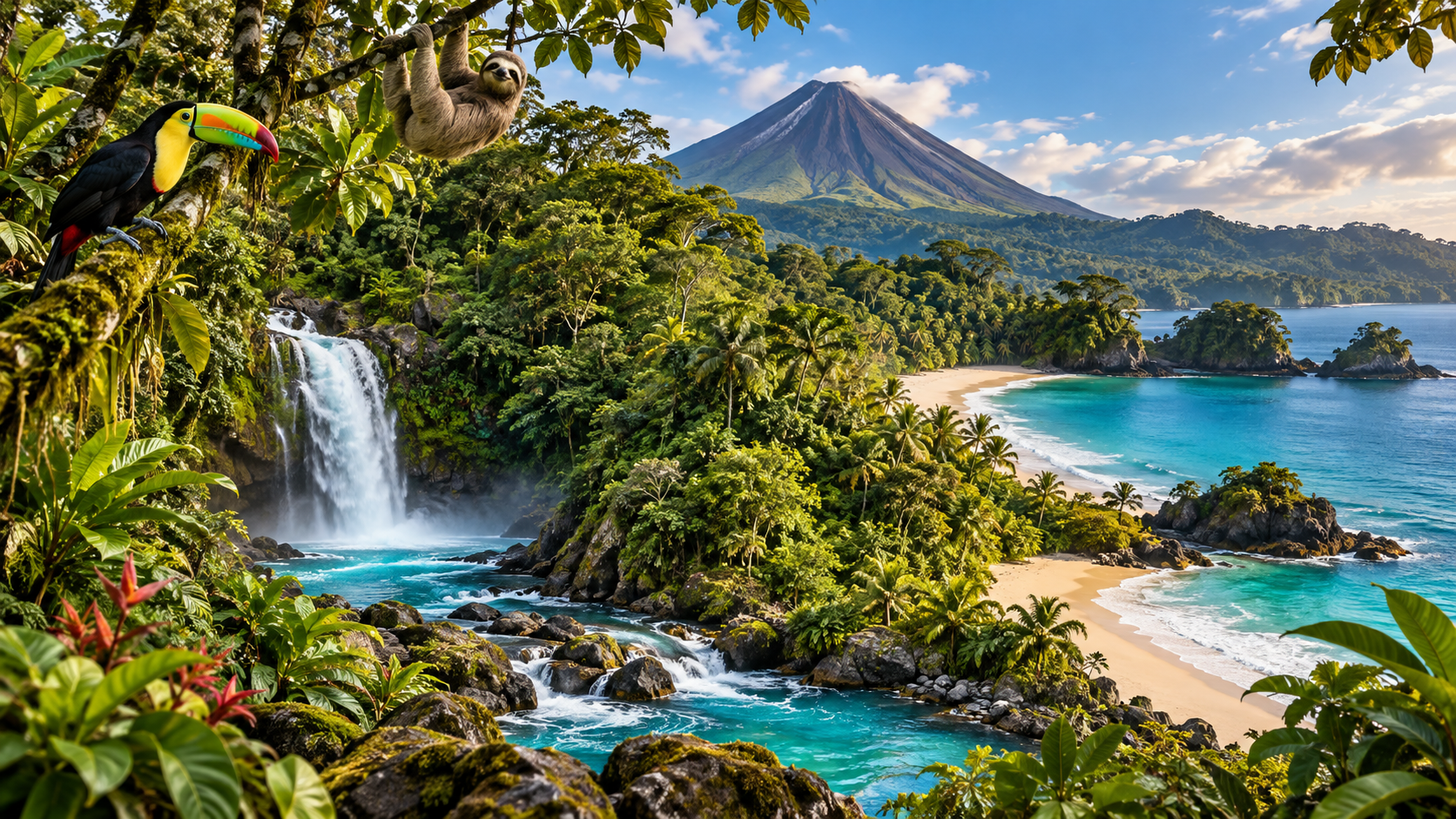
Ask someone what Costa Rica looks like and the answer is usually green.
Very green.
Volcanoes. Rainforest. Waterfalls. Beaches. Sloths hanging from branches as if they have nowhere else to be.
That image is not wrong. Costa Rica really does pack an unusual amount of natural drama into a relatively small country.
But the best costa rica landmarks are not limited to one postcard view.
You can stand beside the crater of an active volcano in the morning, walk through cloud forest that afternoon and reach a Pacific beach by the next day. On another route, you can watch sea turtles on the Caribbean coast, see pre-Columbian stone spheres in the south or hike through one of the most biologically rich forests in Central America.
And then there are the quieter landmarks.
An old church in Orosi. A coffee plantation on a mountain slope. A suspension bridge disappearing into mist. A perfect blue river running through rainforest.
Costa Rica works because nature is not something you visit once and then leave behind.
It follows you everywhere.
First, Understand the Geography
Costa Rica sits between Nicaragua and Panama, with the Pacific Ocean on one side and the Caribbean Sea on the other.
The country is small enough that Americans sometimes underestimate travel time.
Do not.
Mountain roads, weather, narrow highways and national park access can make a short distance on the map take much longer than expected.
Still, that compact geography is part of the appeal.
Within one trip, you can realistically combine volcanoes, forest and coast.
| Landmark | Region | Best Known For |
|---|---|---|
| Arenal Volcano | Northern Costa Rica | Classic volcanic cone, forest and hot springs |
| Manuel Antonio | Central Pacific | Rainforest, beaches and wildlife |
| Monteverde | North-central highlands | Cloud forest and misty trails |
| Poás Volcano | Central Valley | Large volcanic crater |
| Río Celeste | Northern highlands | Bright blue river and waterfall |
| Tortuguero | Caribbean coast | Canals, rainforest and sea turtles |
| Corcovado | Osa Peninsula | Remote rainforest and wildlife |
| Stone Spheres of the Diquís | Southern Costa Rica | Pre-Columbian archaeology |
The easiest strategy is to choose two or three regions.
Trying to see the entire country in seven days usually means seeing a lot of windshield.
Arenal Volcano Is the Classic Costa Rica Landmark
If Costa Rica had to choose one natural landmark for a tourism poster, Arenal would be a strong candidate.
The volcano rises above the northern landscape near La Fortuna with the kind of near-perfect cone people expect volcanoes to have.
Arenal Volcano National Park protects forest, old lava fields and trails around the volcano.
The volcano was intensely active for decades during the late 20th and early 21st centuries, though its activity later decreased significantly.
Today, most visitors come for hiking, scenery and the wider La Fortuna area.
And honestly, the surrounding area matters almost as much as the volcano itself.
Hot springs, waterfalls, hanging bridges and rainforest tours make it easy to spend several days here.
La Fortuna Waterfall Is the Easy Crowd-Pleaser
Near the town of La Fortuna, water drops dramatically into a forested pool below.
The setting is exactly what many people picture when they imagine Costa Rica.
Dense green vegetation surrounds the falls.
The walk down involves plenty of steps.
Which also means the walk back involves those same steps, now pointed in the less enjoyable direction.
Still, it is one of the easiest major waterfalls to combine with an Arenal trip.
The Hot Springs Around Arenal Are Part of the Experience
Volcanic geology has created naturally heated water around the Arenal region.
That has led to a whole hot-spring culture.
Some properties are elaborate resort experiences with landscaped pools, bars and restaurants.
Others are smaller and simpler.
After a wet day of hiking, warm water suddenly feels less like luxury and more like excellent planning.
Monteverde Is What Happens When a Forest Lives Inside a Cloud
Monteverde is one of Costa Rica’s most famous highland destinations.
The cloud forest environment is cooler, wetter and mistier than the lowland rainforest many travelers expect.
Moss covers branches.
Ferns grow everywhere.
Orchids cling to trees.
Clouds move through the forest rather than floating far above it.
The atmosphere can feel almost cinematic.
You do not come here for wide panoramic jungle views.
You come for layers of green disappearing into mist.
Hanging Bridges Let You See the Forest From Another Level
One of the signature experiences around Monteverde is walking through the canopy on suspension bridges.
The bridges cross ravines and treetops, giving you a completely different perspective from ground-level trails.
The forest suddenly feels deeper.
Birds move at eye level.
Clouds drift through the trees.
And yes, if you dislike heights, some bridges may feel longer than their official measurements suggest.
Monteverde Is Also About Birds
Birdwatchers come here looking for species associated with cloud forest, especially the resplendent quetzal.
The quetzal’s long green tail feathers and bright plumage make it one of Central America’s most recognizable birds.
Seeing one is not guaranteed.
Wildlife refuses to respect travel itineraries.
Hiring a knowledgeable local guide dramatically improves your odds of noticing animals you would otherwise walk past.
Manuel Antonio Combines Jungle and Beach Almost Too Perfectly
Manuel Antonio National Park is smaller than some of Costa Rica’s vast protected areas, but it packs a lot into that space.
Tropical forest reaches down toward white-sand beaches and bright Pacific water.
Monkeys move through trees.
Sloths hide above trails.
Iguanas appear where you least expect them.
And raccoons have clearly studied human snack behavior.
The park is one of Costa Rica’s most popular destinations, so planning matters.
Entry is managed through official ticketing, and visitor numbers can be controlled.
Do not arrive assuming there will always be space.
The Beaches Inside Manuel Antonio Are Half the Reason to Go
Many national park visits involve hiking and then more hiking.
Manuel Antonio gives you another option.
Walk through rainforest.
Then swim.
The beaches sit directly beside protected tropical forest, creating one of the country’s best combinations of wildlife viewing and actual vacation time.
Bring only what you need.
Animals are curious, and food rules are taken seriously for good reason.
Poás Volcano Lets You Look Into a Crater Without a Major Expedition
Poás Volcano rises within easy reach of the Central Valley and San José region.
Its main attraction is the crater.
When conditions cooperate, visitors can look across a huge volcanic depression with a striking crater lake below.
The problem is clouds.
Volcanoes have no interest in your vacation schedule.
Mist can arrive quickly and erase the view.
Early visits often give better odds of clear conditions, though nothing is guaranteed.
Access procedures can also change depending on volcanic activity and safety conditions.
Irazú Volcano Feels Almost Lunar
Irazú is another major volcano accessible from the Central Valley.
At more than 11,000 feet above sea level, the environment around the summit feels completely different from tropical lowlands.
The landscape can be cool, windy and stark.
Dark volcanic soil gives parts of the summit a moonlike appearance.
On exceptionally clear days, broad views can stretch toward both sides of the country.
Weather can change fast.
Bring a layer even if San José felt warm when you left.
Río Celeste Looks Like Someone Adjusted the Saturation
Río Celeste in Tenorio Volcano National Park is known for water that can appear intensely turquoise or sky blue.
The color results from natural physical and chemical processes involving minerals and suspended particles in the water.
It is not dye.
It is not Photoshop.
And it does look strangely artificial in person.
The waterfall is the classic viewpoint, where bright blue water drops through dense forest.
The hike can become muddy in wet weather.
Which is very on-brand for Costa Rica.
Tortuguero Is a Place Where Roads Stop Being Useful
Tortuguero sits on the Caribbean coast and is known for wetlands, canals, rainforest and sea turtle nesting.
Much of the area is reached by boat or small aircraft rather than normal road travel.
That changes the experience immediately.
Instead of driving between attractions, you move along waterways bordered by thick vegetation.
Monkeys, caimans, birds and other wildlife may appear along the banks.
During turtle nesting season, guided night walks can offer the chance to observe sea turtles coming ashore under strict rules.
This is one of those situations where following the guide is not optional etiquette.
It protects the animals.
Corcovado Is Costa Rica With the Difficulty Turned Up
Corcovado National Park protects a large area of rainforest on the Osa Peninsula.
It is often described as one of the most biologically intense places in the region.
This is not the easiest national park for a casual afternoon visit.
Access can involve boats, long hikes, guides, advance arrangements and humid tropical conditions.
But the reward is a much wilder experience.
Scarlet macaws are common sights in the region. Tapirs, monkeys, peccaries and many other species live within the park.
If Manuel Antonio is an accessible introduction to Costa Rican rainforest, Corcovado is the extended version.
Drake Bay Makes a Good Base for the Osa Peninsula
Drake Bay sits on the northern side of the Osa Peninsula and is commonly used as a base for Corcovado trips.
The area has beaches, rainforest, boat access and a relaxed atmosphere.
It feels far removed from the busier Pacific resort zones farther north.
That remoteness is part of the point.
Do not come here expecting endless shopping streets and nightlife.
Come because you want jungle.
Cocos Island Is Legendary – but Not a Casual Day Trip
Cocos Island National Park lies hundreds of miles offshore in the Pacific.
It is one of Costa Rica’s UNESCO World Heritage properties and is internationally famous for marine biodiversity.
Divers know it especially for large schools of fish, rays and sharks.
The island’s isolation has helped protect extraordinary marine ecosystems.
But this is not somewhere you casually pop over after breakfast.
Trips involve long boat journeys and specialized diving expeditions.
For most travelers, it remains a dream-list destination rather than a standard itinerary stop.
The Guanacaste Conservation Area Shows a Drier Side of Costa Rica
Not all Costa Rican forest is wet rainforest.
Northwestern Costa Rica includes tropical dry forest, especially within the broader Guanacaste conservation region.
This UNESCO World Heritage property protects a remarkable range of habitats from coast to volcanoes.
During the dry season, some forests lose leaves and look far less lush than the green jungle stereotype.
That seasonal change is part of the ecology.
And it shows how varied Costa Rica really is.
Santa Rosa Carries Both Natural and Historical Importance
Santa Rosa National Park in Guanacaste protects dry forest, coastline and important historical sites.
It is linked to the 1856 Battle of Santa Rosa, a major event in Costa Rican history.
The restored historic building known as La Casona is one of the country’s most meaningful national monuments.
This is a useful place to remember that Costa Rica’s landmarks are not only volcanoes and wildlife.
The Diquís Stone Spheres Are Costa Rica’s Most Mysterious Cultural Landmark
In southern Costa Rica, archaeological sites contain large stone spheres made by pre-Columbian communities.
Some are remarkably round.
Some are small enough to move with effort.
Others weigh many tons.
The exact meaning of the spheres is still debated, but they were associated with settlements and elite spaces in the Diquís region.
Several archaeological locations connected with the spheres are recognized together as a UNESCO World Heritage property.
They are one of the country’s most distinctive cultural landmarks.
Guayabo Shows That Pre-Columbian Costa Rica Was Not Empty Forest
The Guayabo National Monument near Turrialba preserves remains of a large pre-Columbian settlement.
Stone roads, foundations, aqueduct systems and other structures reveal a much more organized landscape than many visitors expect.
Costa Rica is often marketed almost entirely through nature.
That can make its archaeological history disappear.
Guayabo corrects that a little.
Orosi Church Brings a Different Kind of History
The small town of Orosi lies in a green valley southeast of San José.
Its historic church is one of Costa Rica’s best-known colonial-era religious buildings.
The setting matters too.
Mountains, coffee-growing landscapes and a quieter village atmosphere surround the area.
It is a good stop for travelers who want history without a giant urban museum experience.
Cartago and the Basilica of Our Lady of the Angels Matter to Modern Costa Rican Culture
Cartago was once Costa Rica’s capital and remains an important religious center.
The Basilica of Our Lady of the Angels is one of the country’s most significant pilgrimage sites.
Each year, large numbers of Costa Ricans travel toward Cartago for the annual pilgrimage associated with the Virgin of Los Ángeles.
The basilica is therefore more than an attractive building.
It remains part of living religious culture.
San José Is Better If You Know What to Look For
San José rarely wins the beauty contest against Arenal or Manuel Antonio.
That is not really fair.
It is a city, not a waterfall.
The capital contains some of the country’s most important museums and urban landmarks.
The National Theatre is one of the most elegant historic buildings in central San José.
Nearby museums contain pre-Columbian gold, jade, archaeology and national history.
If you arrive through San José, give the center a few hours before immediately escaping toward the rainforest.
The National Theatre Is the City’s Classic Architectural Landmark
Built in the late 19th century, the National Theatre reflects the wealth generated during Costa Rica’s coffee boom.
The interior includes decorative paintings, ornate details and European-influenced design.
It feels far removed from the rainforest image most travelers associate with Costa Rica.
That contrast is useful.
Coffee, urban growth and cultural ambition shaped the country too.
Coffee Country Is a Landmark Even Without One Famous Building
Coffee transformed Costa Rica’s economy and landscape during the 19th century.
Today, plantations cover highland slopes in several regions.
Visiting a coffee farm can show you the process from cherry to roasted bean.
You also begin to understand why altitude matters.
Cooler highland conditions, volcanic soils and seasonal rainfall shape coffee-growing areas around the Central Valley and beyond.
For American visitors who drink coffee every morning, seeing the plant before it becomes a bag on a supermarket shelf is surprisingly satisfying.
Nicoya Peninsula Is Known for Beaches – and Something Else
The Nicoya Peninsula has long been associated with Pacific beaches, surf towns and dry-season sunshine.
It also gained international attention because parts of the peninsula have been studied in discussions of longevity and so-called Blue Zones.
That does not mean drinking coconut water in Nicoya automatically guarantees a 100th birthday.
Life expectancy is shaped by many factors.
Still, the region’s traditional patterns of diet, family ties, activity and social connection have drawn research interest.
Uvita’s Whale Tail Is One of the Most Photogenic Coastal Landmarks
Marino Ballena National Park on the southern Pacific coast is famous for a natural sandbar formation that looks like a whale’s tail from above.
The coincidence is especially good because the region is also known for seasonal humpback whale migration.
At low tide, visitors can walk along the sand formation.
At higher tide, much of it disappears beneath the water.
Check tide timing.
The ocean is running the schedule here.
Cahuita Brings Coral, Rainforest and Caribbean Culture Together
On the Caribbean coast, Cahuita National Park combines forest trails, beaches and marine ecosystems.
The atmosphere differs noticeably from the central Pacific.
Afro-Caribbean culture has a strong presence in the surrounding region.
Food, language, music and architecture reflect histories connected with Caribbean migration and coastal communities.
This is another reason not to treat Costa Rica as culturally uniform.
What Wildlife Can You Actually Expect?
Costa Rica’s reputation for wildlife is deserved.
But animals are not theme-park employees.
You will not automatically see every species on your list.
- Sloths are common in several regions but can be difficult to spot without a guide.
- Howler monkeys often announce themselves before you see them.
- Capuchin monkeys are especially common in some Pacific parks.
- Scarlet macaws can be seen in parts of the Pacific south and central coast.
- Toucans occur in several forest zones.
- Sea turtles nest seasonally on both Caribbean and Pacific beaches.
A good guide is basically a wildlife cheat code.
They see things you would walk past ten times.
What Should You Pack for Costa Rica Landmarks?
Do not pack for “tropical weather.”
Pack for several versions of tropical weather.
- Bring light, quick-drying clothes for hot coastal areas.
- Carry a rain shell even during seasons described as relatively dry.
- Use proper walking shoes for muddy trails.
- Pack a light layer for highland and volcano areas.
- Bring reef-safe sun protection where appropriate.
- Use insect protection in humid lowland environments.
And bring something waterproof for your phone.
Tropical rain has remarkable timing.
When Is the Best Time to Visit?
Costa Rica is often described as having a dry season and a green season rather than four classic seasons.
On much of the Pacific side, the drier period generally runs roughly from December into April.
The wetter months bring greener scenery, fewer crowds in some places and heavier afternoon rain.
The Caribbean side follows different rainfall patterns.
So again, one weather rule does not cover the entire country.
| Period | Advantages | Tradeoff |
|---|---|---|
| December-April | Drier Pacific weather, easier road trips | Higher prices and more visitors |
| May-August | Very green landscapes, some lower prices | Regular rain |
| September-October | Quiet in some Pacific regions | Heavy rain in many areas |
| Caribbean dry windows | Better conditions around the Caribbean coast | Timing differs from Pacific patterns |
The best month depends on where you are actually going.
A First-Time Route Should Be Simple
If you have about ten days, do not build a heroic itinerary.
A simple route works better.
- Start around Arenal or La Fortuna for volcano scenery and rainforest.
- Add Monteverde for cloud forest.
- Finish on the Pacific coast at Manuel Antonio or another beach region.
That route gives you three different ecosystems without spending every day moving hotels.
With two weeks, add Tortuguero, Guanacaste or the Osa Peninsula depending on your interests.
FAQ About Costa Rica Landmarks
What is the most famous landmark in Costa Rica?
Arenal Volcano is one of the country’s most recognizable natural landmarks. Manuel Antonio, Monteverde, Poás Volcano and Río Celeste are also among the best-known destinations.
How many UNESCO World Heritage Sites does Costa Rica have?
As of 2026, Costa Rica has four properties on the UNESCO World Heritage List: three natural properties and one cultural property.
What are the best Costa Rica landmarks for wildlife?
Corcovado, Tortuguero and Manuel Antonio are excellent choices. The best destination depends on whether you want rainforest mammals, birds, sea turtles or a mix of wildlife and beaches.
Is Arenal Volcano still active?
Arenal is considered an active volcano, although the intense eruptive activity seen for decades decreased significantly after 2010. Visitors explore the surrounding national park and old lava areas rather than approaching the crater.
Why is Río Celeste blue?
The river’s color comes from natural optical effects involving mineral particles in the water. It is especially visible where different streams meet inside Tenorio Volcano National Park.
Do you need advance tickets for Costa Rica national parks?
For several popular parks, advance online booking is recommended or required. Manuel Antonio in particular uses official online ticketing, and procedures can change, so check current park rules before visiting.
How many days do you need to see Costa Rica’s major landmarks?
Ten days is enough for three main regions. Two weeks gives a much better pace if you want to combine volcanoes, cloud forest, wildlife and both inland and coastal destinations.
The Best Costa Rica Landmarks Are Really Different Versions of the Same Idea
Costa Rica’s famous places look different.
Arenal is volcanic.
Monteverde is misty.
Manuel Antonio is tropical and bright.
Tortuguero is watery and wild.
Corcovado feels remote.
Río Celeste looks almost unreal.
The Diquís stone spheres tell a human story rather than a geological one.
But all of these places point toward the same larger theme.
Landscape matters here.
It shapes where people live, what grows, what animals survive and what travelers remember.
The country’s most impressive landmarks rarely stand alone.
A volcano sits inside forest.
A beach backs directly onto jungle.
A river changes color because of volcanic geology.
A cloud forest exists because elevation and moisture meet in exactly the right way.
That connectedness is what makes Costa Rica work so well as a travel destination.
You do not need to chase twenty landmarks.
You need to give five of them enough time.
Wake up early for a clear volcano view.
Walk slowly through the forest because the sloth will not wave at you.
Hire a guide once and notice how much wildlife you had been missing.
Get muddy.
Swim when the park allows it.
Watch the weather.
Respect wildlife rules even when another tourist ignores them.
And leave some space in the schedule.
The unexpected moments are usually the ones that stick.
A toucan crossing above a road.
A sudden wall of rain in the afternoon.
Mist lifting from Arenal for exactly five minutes.
A monkey watching you with the suspicious expression of someone who knows you packed snacks.
Those moments are Costa Rica too.
Leave a Reply