
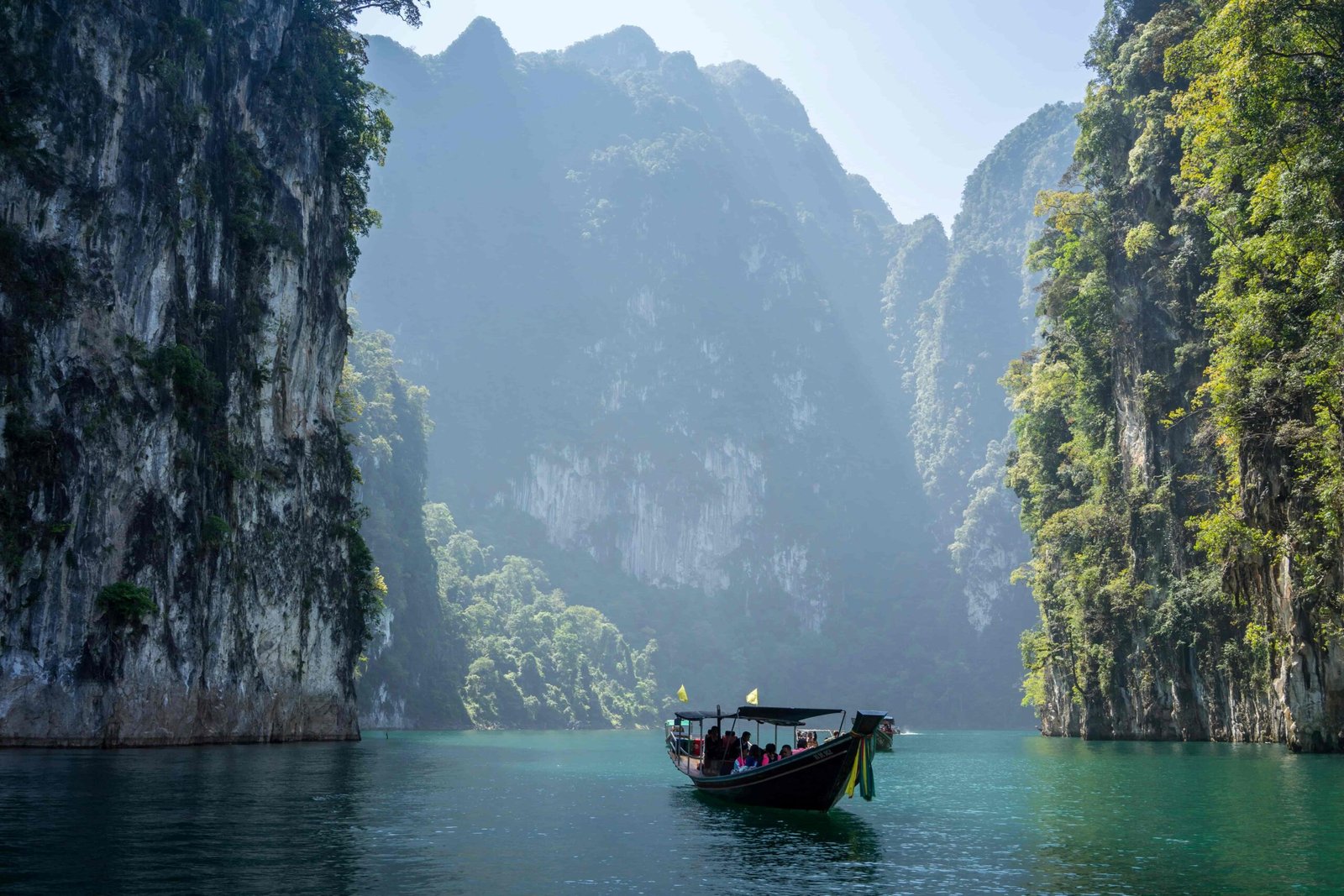
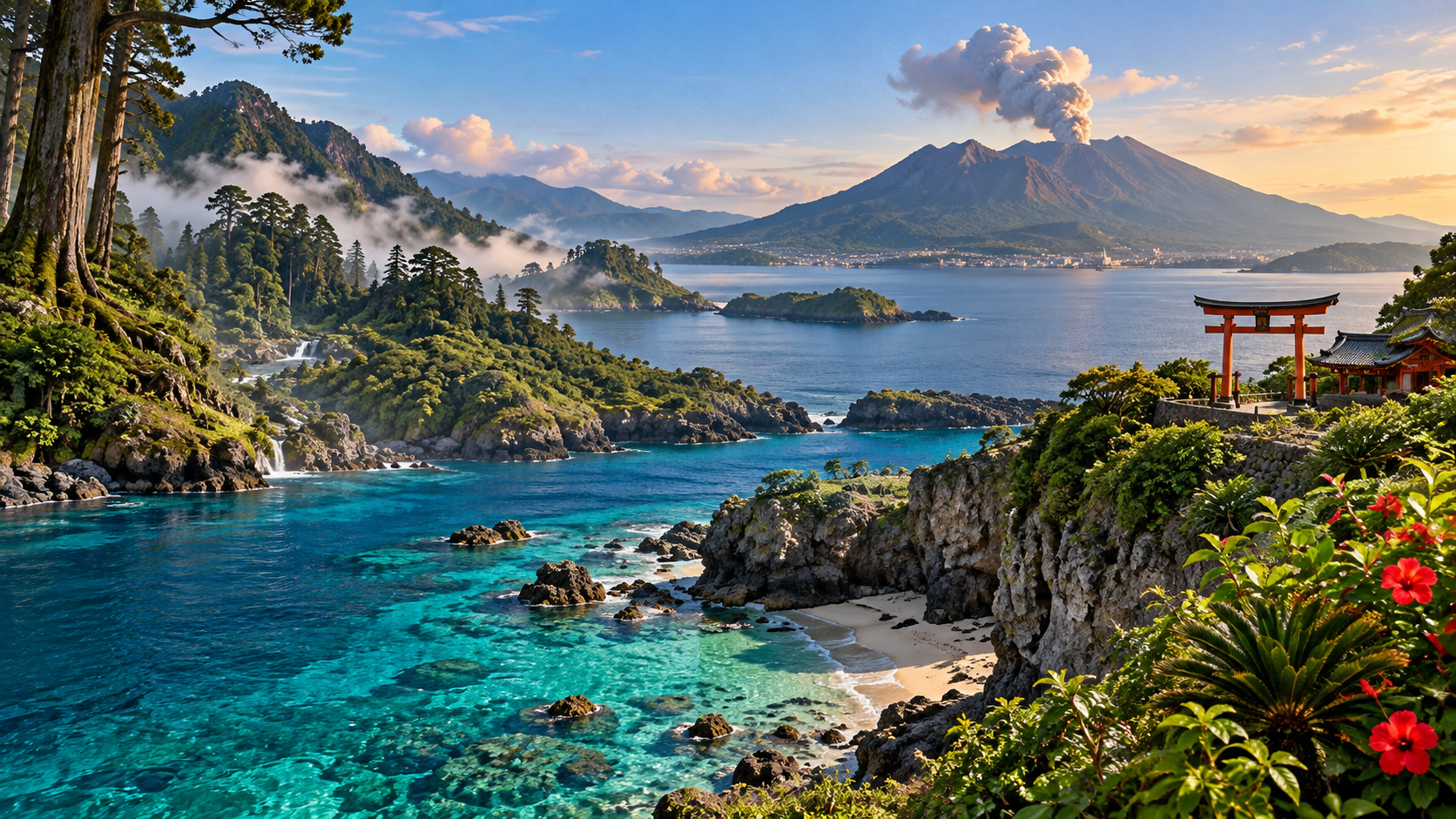
Say “Japan” and many American travelers immediately picture Tokyo crossings, Kyoto temples and maybe snow-covered Mount Fuji.
All fair.
But head south and the mood changes.
South Japan is warmer, more volcanic, more tropical in places and, honestly, often more relaxed. You get steaming hot springs, active volcanoes, subtropical islands, palm-lined beaches, thick cedar forests, old castle towns and food that can taste completely different from what you ate farther north.
And there is no single “south Japan.”
Kyushu feels very different from Okinawa. Shikoku has its own pilgrimage culture and mountain valleys. Kagoshima looks toward Sakurajima. Nagasaki carries a layered international history. Yakushima feels almost prehistoric. Okinawa has a Ryukyuan identity that developed through centuries of contact with China, Southeast Asia, Korea and mainland Japan.
That is the appeal.
Traveling south is not simply seeing more of the same country.
It feels like Japan keeps changing the rules.
What Counts as South Japan?
There is no single official tourism definition that every traveler uses.
In practical trip planning, south japan usually means some combination of Kyushu, Shikoku and Okinawa, sometimes including the southern edge of Honshu as part of a broader route.
For most first-time visitors, Kyushu is the easiest place to start.
It has major cities, fast trains, volcanic landscapes, hot springs and excellent food.
Shikoku is quieter and better suited to travelers who like temples, hiking, rural scenery and slower road trips.
Okinawa is another world again.
The islands are subtropical, the beaches are better, and Ryukyuan history gives the region a cultural identity that goes far beyond “Japan with palm trees.”
| Region | Best Known For | Good For |
|---|---|---|
| Kyushu | Volcanoes, hot springs, food, historic cities | First south Japan trip |
| Shikoku | Temples, mountains, pilgrimage routes | Slow travel and nature |
| Okinawa | Beaches, Ryukyu heritage, islands | Warm-weather trips and diving |
| Yakushima | Ancient cedar forests | Hiking and nature |
| Kagoshima | Sakurajima volcano, shochu, southern culture | Volcanic scenery and food |
| Nagasaki | International history, hills, harbor | Culture and city travel |
Trying to cover all of these in one week is a bad idea.
Pick a region.
Let it breathe.
Fukuoka Is the Easy Gateway
Fukuoka is one of Japan’s most comfortable big cities for travelers.
It has an airport unusually close to downtown, excellent food, a lively nightlife scene and enough urban energy without feeling as overwhelming as Tokyo or Osaka.
For many people, the first reason to come is ramen.
Hakata-style ramen is famous for thin noodles and rich tonkotsu broth made from pork bones.
The noodles are typically firm and fast-cooking, and many ramen shops let you order extra noodles without replacing the broth.
Then there are yatai.
These small outdoor food stalls become part of the evening streetscape, especially around areas such as Nakasu and Tenjin.
Menus vary, but ramen, skewers, dumplings and simple bar food are common.
Some stalls are tiny.
You may end up sitting shoulder-to-shoulder with strangers while a cook works directly in front of you.
That is part of the fun.
Fukuoka Is More Than a Food Stop
The city also makes a good base for day trips and regional travel.
Dazaifu, south of central Fukuoka, is known for Dazaifu Tenmangu, a major shrine associated with scholarship and learning.
Students visit to pray for academic success.
Seasonal plum blossoms bring another layer of atmosphere.
Then there is the waterfront side of Fukuoka, modern shopping districts, beaches and nearby islands.
Still, food tends to win.
You can fight it if you want.
Or you can accept that your itinerary is quietly becoming a meal schedule.
Beppu Is Japan Turned Into Steam
Beppu, on Kyushu’s northeast coast, is one of Japan’s most famous hot-spring cities.
Steam rises between buildings.
Public baths sit beside hotels and ryokan.
Hot water appears everywhere.
The city is associated with multiple hot-spring areas, each with different water qualities and local character.
Some visitors come for traditional bathing.
Others come for the famous “hells,” colorful geothermal pools that are generally for viewing rather than soaking.
Blue pools, reddish water and bubbling mud make the area look slightly unreal.
And yes, there is a whole culture around cooking with geothermal steam.
When a city has this much hot water, people eventually find more uses for it.
How Japanese Onsen Etiquette Actually Works
First-time visitors can get nervous about onsen.
The rules are easier than they sound.
- Wash thoroughly before entering the bath.
- Do not wear a swimsuit unless the facility specifically allows it.
- Keep the small towel out of the bath water.
- Tie long hair up so it does not fall into the water.
- Keep voices low and follow posted rules.
- Check tattoo policies in advance because they vary by facility.
Once you have done it once, the process feels normal.
Then you may start wondering why every hotel in America does not come with a volcanic bath.
Yufuin Is the Softer Version of an Onsen Town
If Beppu feels urban and geothermal, Yufuin feels slower.
The town sits beneath mountains in Oita Prefecture and has become known for ryokan, cafés, small shops and scenic streets.
Lake Kinrin is one of the common walking spots, especially on cool mornings when mist can form above the water.
Yufuin is popular, so “quiet mountain village” is not always accurate during busy hours.
Still, staying overnight changes the mood.
Day-trippers leave.
Baths get quieter.
Dinner becomes the evening.
Mount Aso Shows You How Big a Volcano Can Really Be
Aso in Kumamoto Prefecture is one of Kyushu’s defining landscapes.
The area contains an enormous caldera formed by ancient volcanic activity.
Inside that caldera are towns, fields and active volcanic peaks.
That scale can be hard to understand until you are physically there.
Nakadake is the active crater most visitors associate with Mount Aso.
Access can change depending on volcanic gas, weather and activity levels.
This is one of those attractions where you should never assume yesterday’s access rules still apply today.
Nature gets the final say.
Kumamoto Castle Is One of Japan’s Great Castle Landmarks
Kumamoto Castle is one of Japan’s best-known historic castles.
Its dark exterior, massive stone walls and defensive design make it visually distinct from more delicate temple architecture.
The castle suffered severe damage during the 2016 Kumamoto earthquakes.
Restoration has been a major long-term effort.
Visitors can see both restored areas and the reality of preservation work.
That actually makes the experience more interesting.
You are not simply seeing “an old castle.”
You are seeing how Japan rebuilds and protects heritage after disaster.
Takachiho Feels Like a Japanese Myth Made Physical
Takachiho in Miyazaki Prefecture is known for dramatic gorge scenery and deep connections with Japanese mythology.
The Takachiho Gorge has steep volcanic cliffs, clear water and the famous Manai Falls.
Small rental boats are often the classic experience, giving you a view upward through the narrow gorge.
Nearby shrines connect the region with stories from Shinto mythology, especially tales associated with the sun goddess Amaterasu.
This is one of those places where landscape and legend are hard to separate.
And that is probably exactly why the stories lasted.
Kagoshima Lives in the Shadow of Sakurajima
Few Japanese cities have a relationship with a volcano as direct as Kagoshima’s.
Sakurajima sits across the bay and remains an active volcano.
It is visible from much of the city.
Sometimes it releases ash.
Residents deal with that as part of ordinary life.
The volcano is not simply a tourist attraction in the distance.
It is part of the city’s identity.
Ferries cross the bay frequently, making it easy to get closer to Sakurajima for viewpoints, foot baths and drives around the volcanic landscape.
Kagoshima Food Has Serious Personality
Kagoshima is known for black pork, or kurobuta, which appears in dishes such as tonkatsu and shabu-shabu.
The region is also strongly associated with shochu, a distilled spirit that can be made from sweet potato and other ingredients.
Sweet potato shochu is especially connected with southern Kyushu.
The flavor can be earthy, aromatic or surprisingly clean depending on style.
If sake is the only Japanese alcohol you know, Kyushu fixes that quickly.
Yakushima Is Where South Japan Turns Wild
Yakushima lies south of Kyushu and is one of Japan’s most remarkable natural destinations.
The island became a UNESCO World Heritage property in 1993.
Its forest is famous for ancient Japanese cedar trees, heavy rainfall and dramatic ecological changes caused by elevation.
The island’s best-known tree is Jomon Sugi, an enormous ancient cedar reached by a long and demanding hike.
But you do not need to do that hike to experience the forest.
Shiratani Unsuikyo offers moss-covered trails and giant trees in a setting that feels almost too green to be real.
Rain is part of Yakushima.
Not a scheduling failure.
Pack accordingly.
Yakushima Rewards Slow Travelers
Many visitors underestimate the island because it looks small.
Roads curve around mountains.
Weather changes.
Hikes take time.
Buses are less frequent than in major Japanese cities.
A rushed overnight trip is possible, but it misses the atmosphere.
Two or three nights makes far more sense.
Nagasaki Has One of Japan’s Most Layered Histories
Nagasaki is often discussed through the atomic bombing of 1945, and that history is essential.
But the city’s story is much wider.
For centuries, Nagasaki was one of Japan’s most important points of international contact.
Chinese merchants, European traders and Christian communities all influenced the city.
During Japan’s period of national seclusion, Dutch trade continued through Dejima, an artificial island in Nagasaki harbor.
Today, reconstructed Dejima gives visitors a sense of that controlled exchange.
Nearby hills, churches, Chinese-influenced temples and Western-style residences show how unusually international Nagasaki became.
Nagasaki’s Food Reflects That History Too
Champon is one of the city’s signature dishes.
It combines noodles with vegetables, seafood and other ingredients in a rich soup.
Sara udon uses crispy or soft noodles topped with a thick mixture of vegetables and seafood.
Castella sponge cake, originally influenced by Portuguese baking, became another Nagasaki specialty.
Food history gets very literal here.
Shikoku Is for Travelers Who Want Japan to Slow Down
Shikoku is the smallest of Japan’s four main islands.
It is mountainous, less densely populated and strongly associated with the Shikoku 88 Temple Pilgrimage.
The pilgrimage route links temples connected with the Buddhist monk Kukai, also known as Kobo Daishi.
Some pilgrims walk the entire route.
Others drive or take buses between temples.
White clothing, walking staffs and temple stamps are part of the traditional pilgrimage culture.
You do not need to be Buddhist to experience sections respectfully.
But remember that this is a living religious route, not a hiking challenge invented for tourists.
Iya Valley Shows the Remote Side of Shikoku
The Iya Valley in Tokushima Prefecture is known for steep mountains, deep river valleys and traditional vine bridges.
The landscape feels isolated even by Japanese standards.
Roads can be narrow.
Villages cling to slopes.
Fog changes the scenery in minutes.
This is a good destination for people who enjoy rural Japan and do not need convenience every five minutes.
Renting a car can make travel much easier.
Matsuyama Gives You Castle Views and One Famous Bathhouse
Matsuyama in Ehime Prefecture is known for Matsuyama Castle and Dogo Onsen.
The castle sits on a hill above the city and preserves original structures from Japan’s feudal period.
Dogo Onsen, meanwhile, is associated with one of Japan’s oldest hot-spring traditions.
The historic bathhouse has long been part of the city’s identity.
Together, they make Matsuyama a strong introduction to Shikoku without immediately heading into remote mountains.
Okinawa Is Not Just a Beach Extension of Mainland Japan
This is worth saying clearly.
Okinawa has its own history.
The Ryukyu Kingdom developed across the islands and became an important center of trade and cultural exchange between Japan, China, Korea and Southeast Asia.
UNESCO’s Gusuku Sites and Related Properties of the Kingdom of Ryukyu preserve nine component sites connected with roughly five centuries of Ryukyuan history.
Castle ruins, sacred spaces and gardens show a cultural tradition that evolved differently from mainland Japanese feudal society.
So yes, go for beaches.
But do not leave thinking Okinawa is simply tropical Tokyo.
Shuri Castle Is Central to Ryukyuan History
Shuri was the political center of the Ryukyu Kingdom.
The castle complex reflected Chinese, Japanese and local architectural influences.
A devastating fire in 2019 destroyed major reconstructed buildings, and restoration has continued since then.
The site remains deeply important to Okinawan cultural identity.
Even during reconstruction, visiting provides valuable context for understanding the islands.
Okinawa’s Food Tastes Different Because Its History Is Different
Okinawan cuisine developed through local agriculture, island geography and centuries of trade.
Goya champuru combines bitter melon with tofu, egg and other ingredients.
Okinawa soba uses wheat noodles rather than the buckwheat noodles many Americans associate with soba.
Rafute is slow-cooked pork belly.
Sea grapes, known as umi budo, have a salty pop when eaten.
Awamori is the islands’ traditional distilled spirit.
It is made from long-grain rice and has a history distinct from mainland sake.
The Beaches Get Better as You Move Away From the Main Island
Okinawa Island has beaches, but the outer islands often deliver the water people are really imagining.
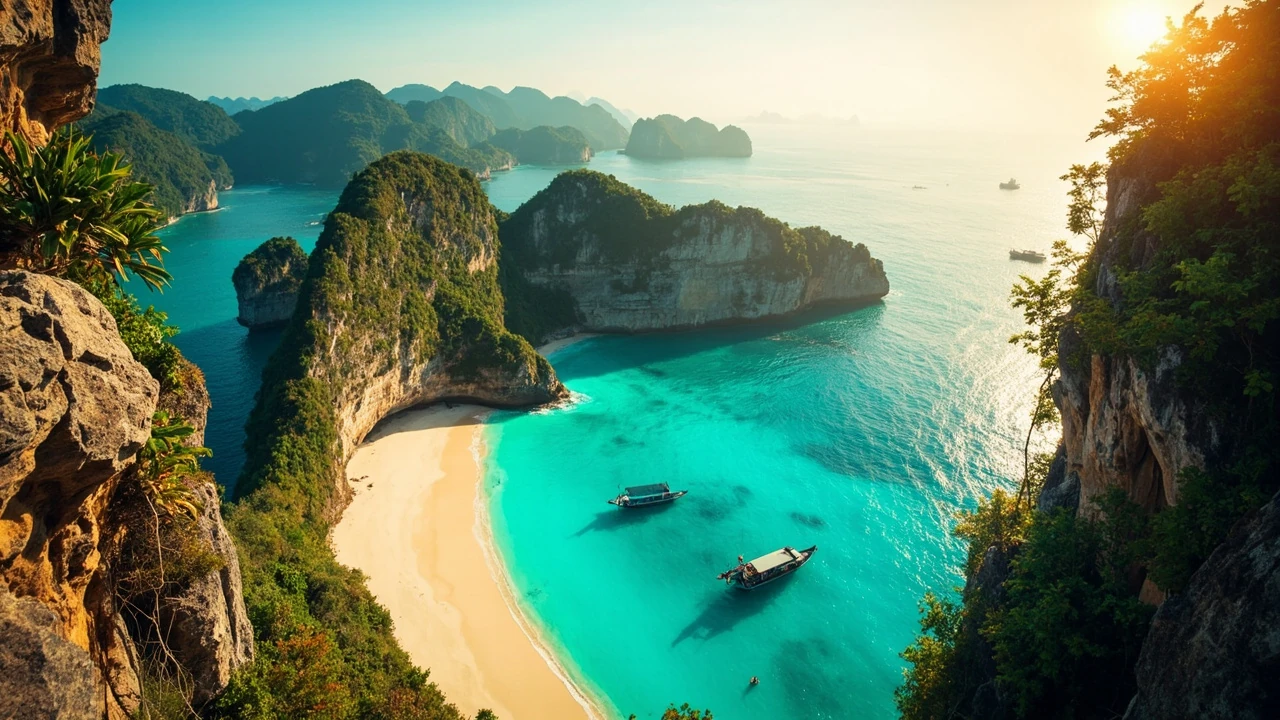
Ishigaki, Miyako and the Yaeyama Islands offer clear sea, coral reefs and a slower island rhythm.
Iriomote is especially wild, with mangroves, forest and endemic wildlife.
In 2021, Amami-Oshima, Tokunoshima, the northern part of Okinawa Island and Iriomote Island were collectively inscribed as a UNESCO natural World Heritage property because of their biodiversity.
This is not just “pretty island scenery.”
The ecosystems are globally significant.
Iriomote Feels Like Japan’s Jungle Side
Iriomote is heavily forested and far less developed than many other resort islands.
Mangrove rivers cut through the landscape.
Waterfalls hide inland.
Kayaking and guided trekking are popular.
The island is also associated with the critically endangered Iriomote cat.
You are extremely unlikely to casually spot one.
Which is good.
Wildlife does not owe us a selfie.
When Is the Best Time to Visit South Japan?
South Japan generally has milder winters than northern and central parts of the country.
But “warm” is relative.
Kyushu can still be cool in winter.
Okinawa is much more subtropical.
Spring is excellent for comfortable temperatures and blossoms.
Early summer brings the rainy season across much of the region.
Late summer and early fall can bring typhoons, especially around southern islands.
Autumn can be beautiful and calmer in many areas.
| Season | Best For | Main Catch |
|---|---|---|
| Spring | Cities, hiking, blossoms | Popular travel season |
| Early summer | Lush scenery | Rainy season in many areas |
| Mid to late summer | Beaches and island trips | Heat, humidity and typhoon risk |
| Autumn | Road trips, hiking, comfortable weather | Typhoons still possible early in season |
| Winter | Onsen, cities, fewer crowds | Cool weather outside Okinawa |
Getting Around Kyushu Is Easier Than You Think
Kyushu has strong rail connections between major cities.
Shinkansen services make Fukuoka, Kumamoto and Kagoshima relatively easy to combine.
Regional trains reach many other destinations.
But trains become less useful once you want rural valleys, volcano viewpoints or small coastal towns.
That is where renting a car starts to make sense.
Japan drives on the left.
Road rules are orderly.
Rural roads can still be narrow enough to make American drivers suddenly very respectful of compact cars.
Food Alone Can Build a South Japan Itinerary
Seriously.
You could organize a trip almost entirely around regional dishes and still end up seeing half of Kyushu.
- Eat Hakata ramen in Fukuoka.
- Try horse-meat dishes in Kumamoto if that is within your comfort zone.
- Order kurobuta pork in Kagoshima.
- Try chicken nanban in Miyazaki.
- Eat champon and castella in Nagasaki.
- Drink sweet-potato shochu in southern Kyushu.
- Try Okinawa soba and goya champuru in Okinawa.
Japan is intensely regional about food.
The south makes that obvious fast.
A Good First South Japan Route
If you have ten to twelve days, keep things simple.
One strong Kyushu route could look like this:
- Start with two nights in Fukuoka.
- Spend one or two nights around Beppu or Yufuin.
- Continue to Kumamoto and the Aso region.
- Head south to Kagoshima.
- Add Yakushima if hiking is a priority.
- Finish with Nagasaki or fly onward to Okinawa if you have more time.
This already gives you cities, volcanoes, hot springs, food and nature.
No need to turn the trip into a transportation endurance test.
Why South Japan Works So Well for Repeat Visitors
First-time Japan trips often focus on Tokyo, Kyoto and Osaka because those cities are easy to understand and full of famous sights.
South Japan works especially well on a second trip.
You already understand train stations.
You know convenience stores are your friend.
You have survived ordering from a ticket machine.
Now you can slow down.
Take regional trains.
Stay in a ryokan.
Rent a tiny car.
Spend two days on an island instead of squeezing in another famous temple.
That is when Japan starts feeling much bigger than the standard tourist route.
FAQ About South Japan
What areas are considered south Japan?
For travel purposes, south Japan usually includes Kyushu, Shikoku and Okinawa, along with nearby southern islands. There is no single strict tourism boundary.
What is south Japan best known for?
South Japan is known for volcanoes, hot springs, regional food, subtropical islands, Ryukyuan culture, ancient forests, historic cities and quieter rural areas.
Is Kyushu worth visiting on a first trip to Japan?
Yes. Kyushu is especially good if you want food, hot springs and nature while still having easy rail connections between major cities.
Is Okinawa culturally different from mainland Japan?
Yes. Okinawa developed from the historic Ryukyu Kingdom and has distinct traditions, cuisine, music, architecture and historical connections with East and Southeast Asia.
What is the best city to start a south Japan trip?
Fukuoka is one of the easiest gateways because its airport is close to downtown and it has excellent rail links across Kyushu.
How many days do you need for south Japan?
Ten days works for a focused Kyushu route. Two to three weeks is better if you want to add Yakushima, Shikoku or Okinawa without rushing.
When is the best time to visit south Japan?
Spring and autumn are generally comfortable for cities and hiking. Summer works well for beaches but brings heat, humidity, rain and possible typhoons, especially farther south.
South Japan Is Where Japan Starts Feeling Less Predictable
That may be the best reason to go.
Tokyo is spectacular.
Kyoto deserves its fame.
Osaka is endlessly fun.
But south japan gives you something different.
Steam rising from the streets in Beppu.
A volcano sitting across the bay from Kagoshima.
Moss-covered cedar trees on Yakushima.
A bowl of tonkotsu ramen eaten outside at midnight in Fukuoka.
Castle ruins in Okinawa that tell a story separate from mainland Japan.
Mangrove rivers on Iriomote.
A quiet temple road in Shikoku.
A cliff-lined gorge in Takachiho.
These places still feel unmistakably Japanese.
They just widen the definition.
And that is what makes traveling south so satisfying.
The food changes.
The climate changes.
The architecture changes.
The pace changes.
Even the relationship with the sea becomes stronger as you move toward the islands.
So do not treat southern Japan as an extra add-on after the “important” parts of the country.
It deserves its own trip.
Start in Fukuoka.
Eat well.
Soak in an onsen.
Stand beside a volcano.
Spend a rainy day in an ancient forest.
Fly farther south and learn why Okinawa has its own cultural story.
And leave some blank space in the itinerary.
South Japan is at its best when you stop racing through it.

Leave a Reply