
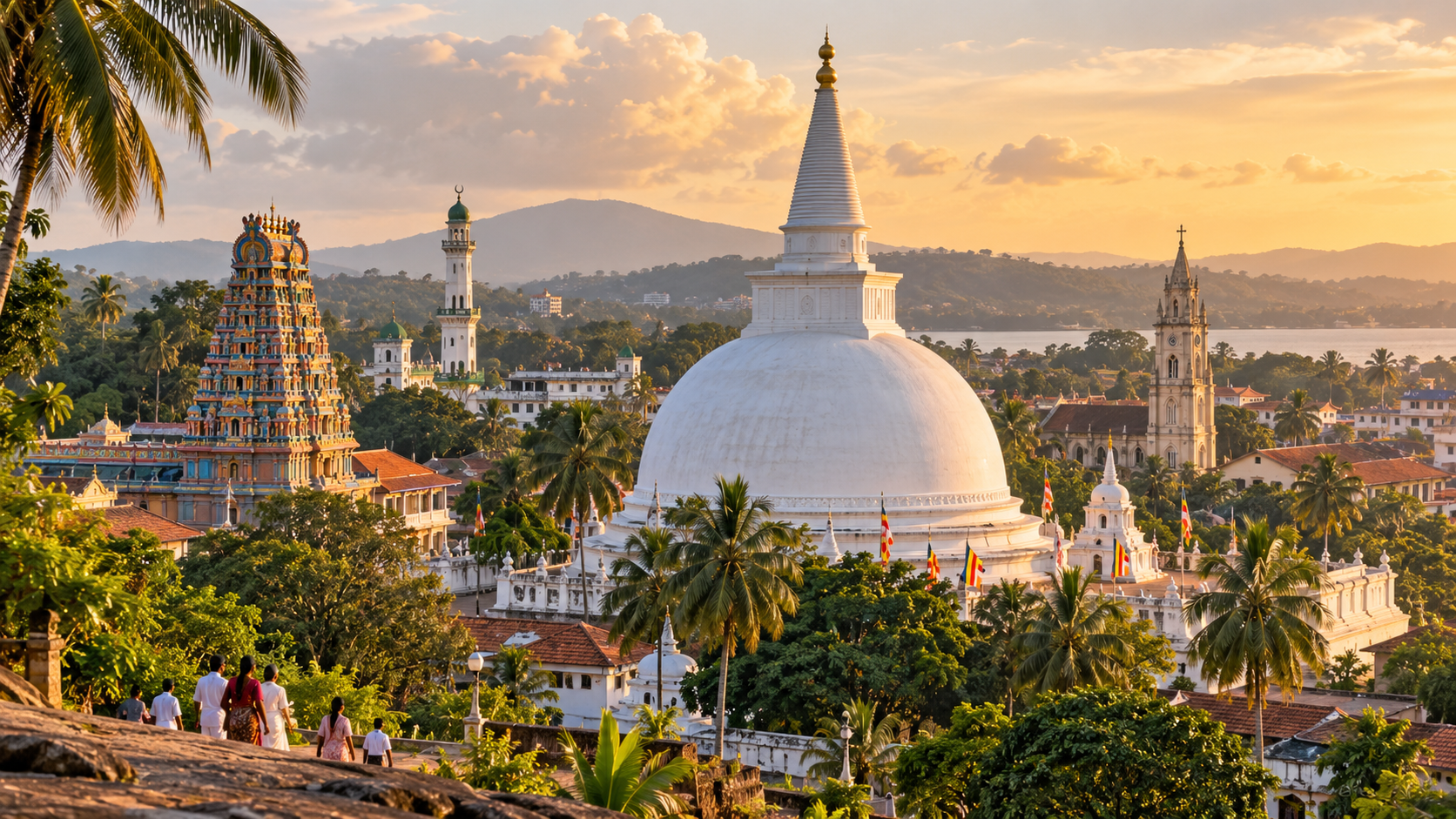
At first glance, Sri Lanka can look unmistakably Buddhist.
White stupas rise above ancient cities. Golden Buddha statues sit beside busy roads. Monks in saffron robes walk through markets and train stations. Bodhi trees grow inside temple compounds, often surrounded by flowers, lamps and people quietly making offerings.
And yes, Buddhism is the largest religion in Sri Lanka.
But that is only the beginning of the story.
Travel north and Hindu temples become much more visible. Walk through parts of Colombo and you may pass a Buddhist temple, Hindu kovil, mosque and Catholic church within the same part of town. Along the west coast, churches are woven into everyday community life. In the east, mosques and Muslim neighborhoods form an important part of the local cultural landscape.
This religious variety did not appear recently.
It grew over centuries through migration, trade, kingdoms, colonial rule and Sri Lanka’s position along major Indian Ocean routes.
That history matters because religion here is not simply about what people believe privately.
It shapes holidays, architecture, food, clothing, family rituals, pilgrimage, art and even the rhythm of certain days of the month.
If you want to understand Sri Lanka, religion is one of the best places to start.
What Are the Main Religions in Sri Lanka?
According to Sri Lanka’s 2024 census, Buddhism remains the country’s largest religion by a wide margin.
Hinduism is the second-largest religious tradition, followed by Islam and Christianity.
The percentages are useful, but geography matters almost as much as the national totals.
Different areas can feel culturally very different from one another.
| Religion | Approximate Share of Population in 2024 | Strong Cultural Presence |
|---|---|---|
| Buddhism | 69.8% | Much of the south, west and central regions |
| Hinduism | 12.6% | Northern and eastern areas, Tamil communities |
| Islam | 10.7% | Urban centers and parts of the east |
| Roman Catholicism | 5.6% | Western and coastal communities |
| Other Christianity | 1.3% | Communities across the island |
Numbers can make religion look neatly separated.
Real life is messier.
People live beside one another. Religious festivals become local events. Shrines attract visitors who may not belong formally to the same faith. Customs can overlap in ways that do not fit clean textbook categories.
That is where Sri Lanka gets interesting.
Theravada Buddhism Shapes Much of the Island’s Identity
Sri Lankan Buddhism belongs mainly to the Theravada tradition, one of the oldest surviving branches of Buddhism.
Its roots on the island go back more than two thousand years.
Traditional accounts connect the introduction of Buddhism to the reign of King Devanampiya Tissa in the 3rd century BCE and to Mahinda, a Buddhist monk traditionally described as the son of the Mauryan emperor Ashoka.
The religion became deeply tied to the Sinhala kingdoms and to ideas of kingship, sacred territory and cultural identity.
That relationship still matters today.
Buddhism is not simply the faith of many individuals. It is embedded in historic cities, literature, festivals, education and public life.
Anuradhapura Shows How Old This Tradition Really Is
Anuradhapura is one of the most important places for understanding Sri Lankan Buddhism.
It served as a political and religious capital for more than a millennium.
The landscape is enormous.
Ancient stupas rise above trees. Monastic ruins stretch across large areas. Reservoirs built by ancient engineers remain part of the environment.
But the most spiritually important site for many visitors is the Sri Maha Bodhi.
According to Buddhist tradition, the sacred fig tree grew from a cutting of the Bodhi tree at Bodh Gaya in India, beneath which the Buddha attained enlightenment.
The cutting is traditionally said to have been brought to Sri Lanka in the 3rd century BCE.
People still come to pray beneath it.
That makes Anuradhapura different from a dead archaeological site.
The ruins are ancient.
The religious life is not.
What Is a Stupa, Anyway?
If you travel around Sri Lanka, you will see large dome-shaped Buddhist structures often called stupas or dagobas.
They can contain sacred relics and serve as places of devotion.
Some are small.
Others are massive enough to dominate the skyline.
The Ruwanwelisaya in Anuradhapura is one of the country’s most revered stupas. Its bright white dome can look almost unreal against a blue sky.
Visitors usually walk around stupas clockwise.
People may carry flowers, light oil lamps or sit quietly in prayer.
Even if you are not Buddhist, the easiest approach is simple: move slowly, observe what others are doing and treat the space as active rather than decorative.
Kandy Is Home to Sri Lanka’s Most Famous Buddhist Relic
Kandy is another key center of Buddhist life.
The Temple of the Sacred Tooth Relic, commonly called Sri Dalada Maligawa, stands beside Kandy Lake.
Tradition holds that the temple houses a tooth relic of the Buddha.
Possession of the relic became historically linked with legitimate royal authority.
That gave the temple both religious and political importance.
Today it remains one of the country’s most important pilgrimage sites.
You will see local worshippers carrying lotus flowers, families arriving together and monks moving through the temple complex.
The atmosphere changes through the day.
During ritual times it can become crowded fast.
Esala Perahera Turns Religion Into a Citywide Spectacle
Kandy’s Esala Perahera is one of Sri Lanka’s best-known religious festivals.
The event traditionally includes processions with dancers, drummers, torchbearers and decorated elephants.
Its connection with the Sacred Tooth Relic gives the festival deep Buddhist importance, though elements of local tradition and Hindu religious culture are also part of its historical development.
For visitors, it is visually spectacular.
But it is not just a show created for tourism.
For many participants and observers, the religious meaning comes first.
Poya Days Change the Monthly Rhythm
One detail that surprises many visitors from the United States is the importance of full-moon days.
In Sri Lanka, each full moon marks a Poya day.
These are public holidays with Buddhist religious significance.
Many Buddhists visit temples, observe religious precepts, meditate or take part in charitable activities.
Alcohol sales are generally restricted on Poya days.
Some businesses may operate differently too.
If you are traveling, check the calendar.
A full moon can quietly change your plans.
Vesak Is One of the Most Beautiful Times to See Buddhist Culture
Vesak commemorates key events associated with the Buddha’s life, traditionally including his birth, enlightenment and passing into parinirvana.
During Vesak, streets and homes can fill with colorful lanterns.
Large illuminated displays appear in cities.
Communities organize dansalas, temporary stalls where food or drinks are offered free to passersby.
The atmosphere mixes devotion, community spirit and a slightly festive nighttime energy.
For a traveler, it is one of the easiest moments to understand how religion moves beyond temple walls.
Hinduism Is Central to Sri Lankan Tamil Culture
Hinduism is the country’s second-largest religion and has a particularly strong presence among Sri Lankan Tamil communities.
Its visibility increases noticeably in the north and parts of the east.
Hindu temples in Sri Lanka are commonly called kovils.
They often look dramatically different from Buddhist temples.
Tall entrance towers may be covered with brightly painted sculptures of gods, goddesses and mythological figures.
Inside, bells ring. Incense fills the air. Priests perform puja rituals. Devotees present flowers, coconuts, fruit and other offerings.
It is energetic, colorful and sensory.
Nallur Kandaswamy Kovil Is One of the North’s Great Religious Sites
Near Jaffna, Nallur Kandaswamy Kovil is one of Sri Lanka’s most important Hindu temples.
The temple is dedicated to Murugan, a deity especially important in Tamil Hindu traditions.
The annual Nallur festival attracts large numbers of worshippers.
Rituals, processions and acts of devotion take place over an extended festival period.
If you visit a Hindu temple, dress modestly and pay attention to footwear rules.
Men may also be asked to remove shirts in certain temple spaces depending on local custom.
Watch what worshippers do rather than assuming every temple follows exactly the same routine.
Trincomalee Brings Hindu Sacred Geography to the Coast
Koneswaram Temple sits dramatically above the sea in Trincomalee.
The location alone is memorable.
Cliffs drop toward blue water while temple structures and religious statues occupy the headland above.
The temple is associated with Shiva and has long-standing importance for Hindu worshippers.
It also reflects something common in Sri Lanka: sacred sites and extraordinary landscapes often occupy the same space.
The journey is part of the experience.
Islam Reached Sri Lanka Through the Indian Ocean
Islam has been present in Sri Lanka for centuries.
Muslim communities developed partly through maritime trade connecting the island with Arab merchants, South India and wider Indian Ocean networks.
Sri Lankan Muslims are not culturally identical to Muslims elsewhere in South Asia.
Many have their own historical traditions, languages and local identities.
Mosques appear across the country, with strong Muslim communities in several eastern districts and urban areas.
Colombo’s urban religious landscape makes the diversity particularly easy to see.
Jami Ul-Alfar Mosque Is Hard to Miss
In Colombo’s Pettah district, the Jami Ul-Alfar Mosque stands out immediately because of its striking red-and-white patterned exterior.
It is one of the city’s most recognizable religious buildings.
Pettah itself is crowded, noisy and full of movement.
Markets spill into streets. Tuk-tuks squeeze through traffic. Shops sell everything from fabric to electronics.
Then this highly distinctive mosque appears amid the chaos.
It is a good example of how religion in Sri Lanka often sits directly inside everyday commercial life rather than being separated from it.
Ramadan and Eid Are Part of Sri Lanka’s Religious Calendar
During Ramadan, observant Muslims fast from dawn until sunset.
Daily routines and food habits shift accordingly.
Families and communities gather for iftar after sunset.
Eid celebrations bring prayer, food and family visits.
In areas with large Muslim populations, travelers may notice stronger changes in restaurant hours or neighborhood rhythms.
Basic respect goes a long way.
No elaborate cultural training required.
Christianity Has Deep Roots on the Island Too
Christian communities form a smaller but highly visible part of Sri Lanka’s religious landscape.
Roman Catholicism is the largest Christian tradition in the country.
Portuguese colonial expansion beginning in the 16th century strengthened Catholic influence, especially in coastal areas.
Dutch rule later encouraged Protestant traditions, while British colonial rule brought further Anglican and Protestant institutions.
That history left churches, schools and communities across the island.
The West Coast Has a Strong Catholic Presence
In places such as Negombo, Catholic churches are especially prominent.
Religious statues, roadside shrines and church festivals are woven into local neighborhoods.
Negombo is sometimes associated strongly with fishing communities and Catholic culture.
Christian festivals such as Christmas are widely visible well beyond strictly Christian households.
Decorations appear in shopping areas and hotels, especially in Colombo and tourist centers.
Colonial History Changed the Religious Landscape
Sri Lanka experienced successive periods of Portuguese, Dutch and British colonial rule.
Each colonial power brought different religious institutions and policies.
The Portuguese promoted Catholicism aggressively in several areas.
The Dutch Reformed Church gained influence under Dutch rule.
British rule expanded Protestant missions, schools and English-language education.
But older Buddhist and Hindu traditions did not disappear.
Instead, the 19th and early 20th centuries saw important Buddhist and Hindu revival movements.
Religious identity became tied not only to faith but also to education, culture and responses to colonial power.
Religion and Ethnicity Often Overlap – but They Are Not the Same Thing
This is one of the easiest mistakes outsiders make.
It is tempting to reduce Sri Lanka to a simple formula:
- Sinhala equals Buddhist.
- Tamil equals Hindu.
- Moor equals Muslim.
- European-influenced communities equal Christian.
Reality does not fit that neatly.
There are Sinhala Christians and Tamil Christians. Not every Tamil is Hindu. Muslim identity includes its own ethnic and cultural histories. Intermarriage and regional traditions add more layers.
So religion and ethnicity can strongly overlap without being interchangeable.
What Does the Constitution Say About Religion?
Sri Lanka’s constitution gives Buddhism a special constitutional position.
It states that the Republic shall give Buddhism the foremost place and that the state has a duty to protect and foster the Buddha Sasana.
At the same time, constitutional provisions recognize freedom of thought, conscience and religion and rights related to religious practice.
For an American reader, this can feel unfamiliar because it differs from the U.S. model of formal separation between government and religion.
It is one example of why political and religious systems should not automatically be interpreted through American categories.
Sri Lanka’s Sacred Places Often Have More Than One Layer
Some religious sites carry meaning across communities and historical periods.
Adam’s Peak is perhaps the clearest example.
The mountain is known in Sinhala as Sri Pada.
Near its summit is a footprint-shaped depression.
Buddhist tradition associates it with the Buddha.
Hindu traditions connect the mountain with Shiva.
Muslim and Christian traditions have historically connected the footprint with Adam or other sacred figures.
People climb the mountain during pilgrimage season, often starting in the middle of the night.
The goal is to reach the summit around sunrise.
There are many stairs.
Very many.
The spiritual experience comes with a serious leg workout.
What Should Travelers Wear at Religious Sites?
Sri Lanka is relaxed in many tourist areas, but sacred spaces are different.
Modest clothing matters.
- Cover shoulders and knees at Buddhist and Hindu religious sites.
- Remove shoes and often hats before entering temple areas.
- Wear socks if hot stone or sand is uncomfortable, where permitted.
- Follow local instructions at mosques and churches.
- Avoid beachwear inside active religious compounds.
- Carry a light scarf or overshirt if your daytime outfit is less modest.
This is not difficult planning.
Throw one lightweight layer in your bag and you are basically prepared.
Do Not Turn Your Back on a Buddha Statue for a Casual Photo
Photography etiquette matters.
In Buddhist culture, posing with your back directly toward a Buddha image can be considered disrespectful.
Climbing onto sacred structures or posing theatrically around religious statues is also a bad idea.
Ask before photographing monks or worshippers closely.
And if a sign says no photography, believe the sign.
Your Instagram feed will survive.
Tattoos Can Create Problems If They Show Buddhist Imagery
This catches some international visitors by surprise.
Visible tattoos depicting the Buddha or Buddhist symbols can be viewed as disrespectful, particularly if sacred imagery is used casually or placed in ways considered inappropriate.
Travelers with such tattoos should keep them covered.
Religious images that may be treated as fashion or decoration elsewhere can have much stronger sacred meaning in Sri Lanka.
Temple Offerings Are Usually Simple
You may see worshippers bringing flowers, lamps, incense, fruit or food.
Lotus flowers are especially common at Buddhist temples.
The offering itself is often less important than the intention behind it.
Flowers also carry a symbolic reminder of impermanence: something beautiful eventually fades.
That idea sits comfortably inside Buddhist teachings about change.
Religion Shapes the Calendar More Than Many Visitors Expect
Sri Lanka has public holidays linked to several religious traditions.
Buddhist Poya days occur monthly.
Hindu festivals such as Thai Pongal and Deepavali are important.
Muslim communities observe Eid festivals.
Good Friday and Christmas reflect the country’s Christian heritage.
| Festival or Observance | Tradition | What Visitors May Notice |
|---|---|---|
| Vesak | Buddhist | Lanterns, temple visits, illuminated displays, free food stalls |
| Poson | Buddhist | Pilgrimage and events connected with Buddhism’s arrival in Sri Lanka |
| Deepavali | Hindu | Lamps, family celebrations and temple worship |
| Thai Pongal | Hindu/Tamil | Harvest traditions, family meals and religious observance |
| Eid al-Fitr | Islam | Prayer, family gatherings and food after Ramadan |
| Christmas | Christian | Church services, decorations and public celebrations |
Dambulla Shows Religion Through Art
The Rangiri Dambulla Cave Temple is one of Sri Lanka’s most impressive Buddhist sites.
Cave interiors contain large numbers of Buddha images, paintings and religious figures.
The contrast is dramatic.
Outside, tropical heat.
Inside, dim chambers filled with painted surfaces and statues.
The site reflects centuries of religious patronage rather than one single construction period.
It is also a good place to slow down.
Racing through cave temples makes everything become a blur of statues remarkably fast.
Polonnaruwa Shows How Buddhism and Royal Power Worked Together
Polonnaruwa became an important medieval capital after Anuradhapura declined.
Its ruins include royal structures, monasteries, stupas and enormous Buddha images.
The Gal Vihara sculptures are especially famous.
Several Buddha figures were carved directly from a large granite rock face.
The reclining Buddha is particularly memorable because of its scale and calm expression.
The whole site makes one point very clearly: religion and kingship were deeply connected in premodern Sri Lanka.
Sri Lankan Religion Is Also About Sound
You hear religion as much as you see it.
Temple drums.
Bells.
Chanting.
The Islamic call to prayer.
Church bells.
Recorded devotional music from shops or homes.
In some towns, several traditions become part of the same everyday soundscape.
For travelers accustomed to religion being relatively private, that can be one of the most noticeable cultural differences.
Food and Religion Sometimes Meet in Unexpected Ways
Dietary traditions vary widely.
Many Buddhists eat meat, while others follow vegetarian practices at particular times.
Hindu dietary customs may involve avoiding beef or following vegetarian diets.
Muslims observe halal dietary rules and avoid pork and alcohol.
Some Christian communities have their own fasting or feast traditions.
Visitors rarely need to memorize all of this.
Just avoid assuming everyone eats the same things because everyone lives on the same island.
How to Visit Sacred Sites Without Feeling Awkward
You do not need to understand every ritual.
Most local people do not expect foreign visitors to arrive as religious scholars.
Simple behavior works:
- Dress modestly.
- Move quietly when people are praying.
- Watch before joining a ritual.
- Do not touch sacred objects without permission.
- Ask before taking close photos of people.
- Follow signs and instructions from temple staff.
Respect is much easier than perfect cultural knowledge.
Religion Looks Different Between Colombo, Jaffna and Kandy
If you stay only in one part of Sri Lanka, your impression of the country’s religion can become distorted.
Kandy and much of the central region make Buddhism highly visible.
Jaffna’s Hindu temples and Tamil culture create a very different atmosphere.
Colombo is much more mixed.
Mosques, churches, Hindu temples and Buddhist institutions sit inside a busy modern metropolis.
Negombo has strong Catholic traditions.
Eastern areas include significant Muslim and Hindu communities.
The island is small.
Its religious geography is not.
FAQ About Sri Lanka Religion
What is the main religion in Sri Lanka?
Buddhism is the largest religion. According to the 2024 census, about 69.8% of Sri Lanka’s population identifies as Buddhist, mainly within the Theravada tradition.
Is Sri Lanka a Buddhist country?
Sri Lanka has a Buddhist majority and Buddhism holds a special position under the constitution. However, large Hindu, Muslim and Christian communities are also an established part of the country’s society and history.
What percentage of Sri Lanka is Hindu?
The 2024 census reported that approximately 12.6% of Sri Lanka’s population is Hindu. Hinduism is especially important among Tamil communities in the north and east.
Are there Muslims in Sri Lanka?
Yes. Muslims make up roughly 10.7% of the population according to the 2024 census. Muslim communities have existed on the island for centuries and have strong historical links with Indian Ocean trade.
Are there Christians in Sri Lanka?
Yes. Roman Catholics account for about 5.6% of the population, while other Christian groups account for roughly 1.3%. Christian communities are particularly visible in some western and coastal areas.
Can tourists enter Buddhist and Hindu temples in Sri Lanka?
Usually yes, although specific areas may be restricted. Visitors should wear modest clothing, remove shoes where required and respect worshippers and photography rules.
What are the most important religious sites in Sri Lanka?
Major sites include the Temple of the Sacred Tooth Relic in Kandy, Anuradhapura’s sacred Buddhist monuments, Dambulla Cave Temple, Sri Pada or Adam’s Peak, Nallur Kandaswamy Kovil and Koneswaram Temple.
Religion Is One of the Best Ways to Understand Sri Lanka
You can visit Sri Lanka for beaches.
You can come for elephants, tea country, surfing or train rides through green mountains.
But religion quietly connects many of the places travelers remember most.
The giant stupas of Anuradhapura are religious monuments.
Kandy’s most famous building exists because of a sacred relic.
Dambulla’s caves are filled with centuries of Buddhist devotion.
Nallur’s festival transforms part of Jaffna around Hindu worship.
Mosques tell the story of Indian Ocean trade.
Coastal churches carry traces of European colonial history.
Even climbing Sri Pada can mean different things depending on who is making the journey.
That is the interesting part of sri lanka religion.
It is not one faith replacing another across different sections of a map.
It is layers.
Ancient Buddhism connected with royal kingdoms. Hindu traditions linked with Tamil culture and South India. Islam carried through centuries of maritime exchange. Christianity shaped by Portuguese, Dutch and British periods, then rooted locally across generations.
Those traditions now share a relatively small island.
Sometimes they appear separately.
Sometimes they sit on the same street.
Sometimes communities participate in customs that outsiders would expect to remain neatly divided.
And that is why simply saying “Sri Lanka is Buddhist” misses so much.
Buddhism is central. Very central.
But Sri Lanka’s actual religious landscape is more colorful, regional and historically layered than that sentence suggests.
If you travel through the country, pay attention to the small things.
The white clothes worn by worshippers on a Poya day.
Lotus flowers stacked beside a temple entrance.
A brightly painted Hindu gopuram rising above Jaffna.
The evening call to prayer in a Muslim neighborhood.
A Catholic shrine beside a coastal road.
A bus passing all of them in the same afternoon.
That is Sri Lanka too.
Leave a Reply