

When Americans picture French history, a few images tend to show up immediately.
Versailles. Joan of Arc. The French Revolution. Napoleon standing dramatically in a painting. Maybe a guillotine if school history class left a strong impression.
All of those belong to the story.
But they arrive pretty late.
The history of France stretches back through Roman Gaul, Celtic societies, Frankish kings, medieval monasteries, feudal wars, royal dynasties, religious conflict and centuries of slow political consolidation before anything resembling modern France appeared.
Even the name “France” comes from the Franks, a Germanic people who became dominant after Roman authority in western Europe weakened.
And Paris?
Important, yes.
But France was built from many regions that once had strong identities, languages and rulers of their own.
Brittany, Burgundy, Normandy, Provence, Aquitaine, Alsace and Occitania did not always behave like pieces of one neat national puzzle.
That puzzle took centuries to assemble.
Before France, There Was Gaul
Long before France became a kingdom, much of the territory was known to the Romans as Gaul.
Gaul was inhabited by numerous Celtic-speaking peoples rather than one unified “Gallic nation.”
Different tribes controlled different territories.
They traded, fought and formed temporary alliances.
Some lived in fortified settlements known as oppida.
They practiced agriculture, metalworking and long-distance commerce.
Greek traders had already established Marseille, known in antiquity as Massalia, centuries before Rome conquered most of the region.
So Gaul was not an isolated wilderness waiting for Rome to arrive.
It was already connected to the Mediterranean world.
Julius Caesar Changed the Region Completely
Between 58 and 50 BCE, Julius Caesar led a series of campaigns that brought most of Gaul under Roman control.
His own account, the Commentarii de Bello Gallico, or Commentaries on the Gallic War, became one of the best-known surviving descriptions of the conquest.
It is also propaganda.
Caesar was writing about Caesar.
Worth remembering.
The most famous Gallic resistance leader was Vercingetorix, who united several tribes against Rome.
He won a major victory at Gergovia but was eventually defeated at the Siege of Alesia in 52 BCE.
That defeat became a symbolic turning point.
Roman rule followed.
Roman Gaul Lasted for Centuries
After conquest, Gaul gradually became integrated into the Roman Empire.
Latin spread through administration, trade and urban life.
Roads connected cities.
Aqueducts, amphitheaters, temples and baths appeared.
Some of these structures are still visible today.
The Pont du Gard in southern France is one of the most famous surviving Roman aqueduct bridges.
Nîmes preserves an impressive Roman amphitheater and the Maison Carrée temple.
Lyon, then called Lugdunum, became a major administrative center.
Paris began as Lutetia, a settlement associated with the Parisii people.
Romanization did not erase local culture overnight.
Instead, Gallo-Roman society developed through a mixture of Roman institutions and local traditions.
That mixture became one of the foundations of later French culture.
Christianity Spread During the Roman Period
Christian communities appeared in Gaul during the Roman era.
By late antiquity, Christianity had become deeply established.
Bishops gained social and political importance as Roman institutions weakened.
Church networks sometimes remained stable when imperial administration did not.
That mattered enormously after Rome’s western empire collapsed.
When central political authority broke apart, the church became one of the institutions capable of preserving literacy, administration and local continuity.
The Fall of Rome Did Not Produce France Overnight
During the fifth century, Roman authority in western Europe weakened dramatically.
Germanic groups moved into former imperial territories.
Visigoths controlled parts of southwestern Gaul.
Burgundians established power in the southeast.
Franks expanded from the north.
The Franks eventually became the most important.
Their name would stick.
Clovis Became a Foundational French King
Clovis I ruled the Salian Franks around the turn of the sixth century.
He defeated rivals, expanded his territory and established Merovingian rule over much of Gaul.
His conversion to Christianity was especially significant.
Unlike several other Germanic rulers who followed Arian Christianity, Clovis adopted the Catholic form practiced by much of the Gallo-Roman population.
That strengthened his relationship with bishops and local elites.
Later French rulers looked back at Clovis as an early founder figure.
Was he “King of France” in the modern sense?
No.
But later France grew partly from the political world he helped build.
The Merovingians Gave Way to the Carolingians
Over time, Merovingian kings lost practical power to powerful officials known as mayors of the palace.
One family became dominant.
Charles Martel, famous for defeating an Umayyad force near Tours or Poitiers in 732, belonged to this line.
His son Pepin the Short became king of the Franks in 751.
Then came Pepin’s son.
Charlemagne.
And things got much bigger.
Charlemagne Built an Empire, Not Modern France
Charlemagne expanded Frankish rule across large parts of western and central Europe.
In the year 800, Pope Leo III crowned him emperor in Rome.
His empire included territory that now lies in France, Germany, Italy, Belgium, the Netherlands and several other countries.
So calling Charlemagne simply “French” creates problems.
Modern national borders did not exist.
Both French and German historical traditions later claimed parts of his legacy.
After Charlemagne’s death, his empire was divided among descendants.
The Treaty of Verdun in 843 split the Carolingian Empire into three major regions.
The western portion, West Francia, became the main territorial ancestor of the Kingdom of France.
| Period | Approximate Dates | Why It Matters |
|---|---|---|
| Gaul | Before 1st century BCE | Celtic societies dominated much of the region |
| Roman Gaul | 1st century BCE-5th century CE | Roman administration, language and cities reshape Gaul |
| Merovingian Era | 5th-8th centuries | Frankish kingdoms expand after Roman rule |
| Carolingian Era | 8th-10th centuries | Charlemagne’s empire and division of Frankish lands |
| Capetian France | From 987 | Long-term consolidation of royal authority |
| Ancien Régime | Late medieval period-1789 | Monarchy becomes increasingly centralized |
| French Revolution | 1789-1799 | Monarchy falls and political order is remade |
The Capetian Dynasty Began With a Surprisingly Small Power Base
In 987, Hugh Capet was elected king.
That date is often used as a major starting point for the long development of medieval France.
But Hugh Capet did not control the entire territory shown on a modern map of France.
Far from it.
Powerful dukes and counts controlled enormous regions.
The king’s direct lands were concentrated around Paris and Orléans.
The monarchy had prestige.
Local nobles had armies.
That balance took centuries to change.
Normandy Became One of Medieval Europe’s Biggest Players
In the early 10th century, Viking settlers established themselves in northern France.
The region became Normandy.
Its rulers quickly adopted Christianity and the French language while retaining a strong military culture.
Then, in 1066, Duke William of Normandy crossed the English Channel and conquered England.
He became William the Conqueror.
That event tied English and French history together in a very inconvenient way.
For centuries afterward, English kings held major territories in France.
They were kings in England but also feudal lords inside the French political system.
You can probably guess that this arrangement did not remain peaceful.
Eleanor of Aquitaine Made the Situation Even More Complicated
Eleanor of Aquitaine controlled enormous territories in southwestern France.
She first married Louis VII of France.
That marriage was annulled.
She then married Henry Plantagenet, who soon became Henry II of England.
The result?
The English crown suddenly controlled huge sections of western France.
The French monarchy spent generations trying to recover those lands.
Medieval French history starts making much more sense when you realize the kings of England were not simply foreign enemies arriving from another island.
They were deeply embedded in French feudal politics.
Medieval France Was Built Around Lords, Land and the Church
Most people lived in rural communities.
Political authority was fragmented.
Local lords controlled castles and agricultural estates.
The church operated monasteries, schools and hospitals and owned substantial land.
Cathedral construction transformed growing cities.
Gothic architecture developed in medieval France before spreading across Europe.
Some of the most famous examples include Notre-Dame de Paris, Chartres Cathedral, Amiens Cathedral and Reims Cathedral.
These buildings were not simply decoration.
They represented faith, civic pride, money and technical knowledge.
Paris Slowly Became the Center
Paris benefited from its location on the Seine River and from Capetian royal power.
The city grew into a political, commercial and intellectual center.
The University of Paris became one of medieval Europe’s leading centers of learning.
Markets expanded.
Royal administration became more concentrated around the capital.
Paris did not become important in one dramatic moment.
It accumulated importance.
That is usually how cities win.
The Hundred Years’ War Lasted More Than a Hundred Years
The Hundred Years’ War was a series of conflicts between the English and French crowns beginning in 1337 and ending in 1453.
So yes, the name is approximate.
The dispute involved dynastic claims, territory and control over regions of France.
England won several famous battles, including Crécy in 1346 and Agincourt in 1415.
English longbowmen became legendary.
France experienced military disaster, internal division and political crisis.
Then Joan of Arc entered the story.
Joan of Arc Became a Symbol Long Before France Was Finished Becoming France
Joan of Arc was a teenage peasant who claimed divine guidance during one of the darkest periods of the war.
In 1429, she helped inspire French forces during the relief of Orléans.
She also supported Charles VII’s claim and helped create momentum for his coronation at Reims.
Joan was captured in 1430, handed to English allies and tried for heresy.
She was executed by burning in Rouen in 1431.
Decades later, a retrial overturned the original judgment.
She was canonized by the Catholic Church in 1920.
Her historical image has been reused endlessly ever since.
Saint. Warrior. National heroine. Political symbol.
History rarely lets famous people rest quietly.
The End of the Hundred Years’ War Strengthened the French Monarchy
By 1453, England had lost nearly all of its territories in France except Calais.
French kings emerged with greater authority.
Permanent taxation became more established.
Royal armies became more professional.
Regional noble power remained important, but the long trend was toward greater centralization.
The monarchy was becoming something closer to a state.
The Renaissance Arrived With Italian Influence
During the late 15th and 16th centuries, French kings became deeply involved in Italy.
Military campaigns were costly, but cultural influence flowed north.
Italian Renaissance art, architecture and court culture shaped French elites.
King Francis I became one of the great royal patrons of the period.
He brought Leonardo da Vinci to France during the artist’s final years.
French château architecture developed spectacularly in the Loire Valley.
Chambord is the classic example.
It looks like a medieval castle and a Renaissance palace had an argument and decided to become one building.
Religion Tore France Apart in the 16th Century
The Protestant Reformation reached France and gained followers known as Huguenots.
Most of the population remained Catholic.
Tension became violence.
The French Wars of Religion lasted for decades during the second half of the 16th century.
Massacres, assassinations and dynastic conflict turned religion into a political battlefield.
The most infamous episode was the St. Bartholomew’s Day Massacre in 1572, when thousands of Protestants were killed in Paris and other cities.
Henry IV Helped End the Religious Wars
Henry of Navarre became Henry IV of France in 1589.
He had been a Protestant but converted to Catholicism as part of consolidating his rule.
In 1598, he issued the Edict of Nantes.
The edict granted important rights and protections to Huguenots while maintaining Catholicism’s privileged status.
It did not create modern religious freedom.
But after decades of civil war, it helped stabilize the kingdom.
Louis XIV Turned Royal Power Into Theater
If one French king represents absolute monarchy, it is Louis XIV.
He became king in 1643 and ruled until 1715.
That is an extraordinarily long reign.
Louis strengthened central royal authority and surrounded kingship with elaborate ceremony.
Versailles became the ultimate symbol.
The palace was not merely a giant luxury residence.
It was a political machine.
Powerful nobles were drawn into court life where access to the king, rooms, ceremonies and privileges mattered.
Keeping nobles close helped the monarchy keep an eye on them too.
Versailles Was Expensive for a Reason
The Hall of Mirrors, formal gardens, fountains and enormous apartments displayed wealth on a spectacular scale.
Foreign visitors were supposed to understand one message immediately.
France was powerful.
French court culture influenced European fashion, language, diplomacy and architecture.
But war and royal spending were expensive.
Those financial pressures did not disappear after Louis XIV died.
They accumulated.
The Enlightenment Made Old Political Ideas Harder to Defend
During the 18th century, French thinkers became central to the Enlightenment.
Voltaire attacked intolerance and arbitrary authority.
Montesquieu analyzed political systems and separation of powers.
Rousseau wrote about political legitimacy and popular sovereignty.
Diderot helped direct the Encyclopédie, an ambitious effort to organize human knowledge.
These thinkers did not all agree.
Not even close.
But together they contributed to an intellectual climate where monarchy, church authority and inherited privilege could be questioned publicly.
Why Did the French Revolution Happen?
There is no single reason.
That answer is less dramatic but more accurate.
By the late 1780s, the monarchy faced a severe financial crisis.
France had spent heavily on wars, including support for the American Revolution.
The taxation system was inefficient and unequal.
Society was formally divided into estates, while privileged groups enjoyed exemptions ordinary people resented.
Food prices and poor harvests increased pressure.
Political frustration grew.
Enlightenment ideas provided a language for criticizing the system.
- The monarchy faced heavy debt and fiscal problems.
- The tax system placed unequal burdens on different social groups.
- Food prices created hardship for ordinary households.
- Political representation was widely disputed.
- Enlightenment ideas challenged traditional privilege.
Then, in 1789, the crisis became a revolution.
The Bastille Became Famous Mostly Because of What It Represented
On July 14, 1789, crowds in Paris stormed the Bastille.
The fortress-prison held only a handful of prisoners at the time.
That was not the point.
The Bastille represented royal authority and arbitrary imprisonment.
Its capture became one of the defining symbols of the Revolution.
July 14 remains France’s national day.
1789 Changed the Language of Politics
The National Assembly abolished many feudal privileges.
The Declaration of the Rights of Man and of the Citizen proclaimed principles including legal equality and popular sovereignty.
The old social order began breaking apart.
Church property was nationalized.
Administrative structures changed.
Titles and privileges came under attack.
Revolutionary France was not simply replacing one king with another ruler.
It was trying to redesign society.
Then the Revolution Became Much More Radical
France declared a republic in 1792.
King Louis XVI was executed in January 1793.
Queen Marie Antoinette followed later that year.
War with European monarchies intensified.
Internal rebellions added pressure.
The Committee of Public Safety gained enormous power.
The period known as the Reign of Terror saw thousands executed as supposed enemies of the Revolution.
Maximilien Robespierre became closely associated with this phase.
He eventually went to the guillotine too.
Revolutions can become remarkably efficient at eating their own leaders.
Napoleon Rose From the Chaos
Napoleon Bonaparte was born on Corsica in 1769.
He built his reputation as a military officer during the revolutionary wars.
In 1799, he participated in a coup and became First Consul.
In 1804, he crowned himself Emperor of the French.
Napoleon combined revolutionary reforms with authoritarian rule.
That contradiction is central to understanding him.
He preserved legal equality for men in many areas, reorganized administration and introduced the Napoleonic Code.
At the same time, political opposition was restricted, wars expanded across Europe and slavery was restored in French colonies where it had previously been abolished.
The Napoleonic Code Outlasted Napoleon’s Empire
The Civil Code of 1804 standardized major areas of law.
Its influence extended far beyond France.
Legal systems across parts of Europe and other regions adopted elements of it.
Napoleon’s armies eventually lost.
His legal legacy did not.
Napoleon Dominated Europe – Until He Didn’t
French armies won major victories at places such as Austerlitz and Jena.
For a time, Napoleon dominated much of continental Europe.
Then problems accumulated.
The Peninsular War drained resources.
The invasion of Russia in 1812 became disastrous.
European powers formed new coalitions against him.
Napoleon abdicated in 1814 and was sent to Elba.
Then he returned.
Because apparently one ending was not dramatic enough.
His Hundred Days ended with defeat at Waterloo in 1815.
He spent the rest of his life in exile on Saint Helena.
France Spent the 19th Century Trying Several Governments
After Napoleon, the Bourbon monarchy was restored.
Then came another revolution in 1830.
Another monarchy followed.
Then the Revolution of 1848 created the Second Republic.
Louis-Napoléon Bonaparte, Napoleon’s nephew, was elected president.
He later seized power and became Emperor Napoleon III.
The Second Empire lasted until France’s defeat in the Franco-Prussian War in 1870.
Then came the Third Republic.
Keeping track of 19th-century French regimes feels slightly like following a complicated television series.
| Political System | Dates | Major Feature |
|---|---|---|
| Ancien Régime Monarchy | Before 1789 | Hereditary monarchy and estate-based society |
| First Republic | 1792-1804 | Revolutionary government |
| First Empire | 1804-1814/1815 | Napoleon Bonaparte |
| Restored Monarchy | 1814/1815-1848 | Bourbon and July monarchies |
| Second Republic | 1848-1852 | Universal male suffrage introduced |
| Second Empire | 1852-1870 | Napoleon III |
| Third Republic | 1870-1940 | Long-lasting republican parliamentary system |
Napoleon III Helped Create the Paris Tourists Recognize Today
During the Second Empire, Paris underwent enormous reconstruction under Baron Georges-Eugène Haussmann.
Medieval neighborhoods were cut through by wide boulevards.
Sewer systems improved.
Parks and public spaces expanded.
Uniform building facades transformed major streets.
This rebuilding had practical benefits.
It also displaced residents and made the city easier for authorities to control.
The Paris of grand boulevards, cafés and matching stone buildings owes a lot to this period.
Industrialization Changed Daily Life
During the 19th century, railroads connected regions more closely.
Factories expanded.
Urban populations grew.
Mass newspapers and education helped spread a stronger national French identity.
Regional languages such as Breton, Occitan, Basque, Corsican and Alsatian continued to be spoken, but state education increasingly promoted standard French.
The creation of a modern nation was partly about rail lines and laws.
It was also about teaching millions of people to speak, read and imagine themselves as citizens of the same country.
The Eiffel Tower Was Supposed to Be Temporary
The Eiffel Tower was completed for the 1889 Exposition Universelle, marking the centennial of the French Revolution.
Many artists and writers hated it.
They thought the iron structure was ugly.
That opinion aged poorly.
The tower proved useful for communications and remained standing.
Today it is probably the most recognizable structure in France.
France Built a Huge Colonial Empire
During the 19th and early 20th centuries, France expanded colonial rule across large parts of Africa, Southeast Asia, the Caribbean and the Pacific.
French colonial history shaped language, migration, trade and culture far beyond Europe.
It also involved conquest, coercion, economic exploitation and violence.
Modern France cannot be understood fully without this history.
Neither can many former French colonies.
World War I Devastated France
France became one of the main battlefields of World War I from 1914 to 1918.
Northeastern regions suffered immense destruction.
The Battle of Verdun in 1916 became one of the war’s defining symbols.
Hundreds of thousands of soldiers were killed or wounded there.
The war left an entire generation marked by death and disability.
Memorials to World War I appear in towns across France because virtually every community lost people.
World War II Brought Occupation and Resistance
Germany invaded France in May 1940.
French defenses collapsed rapidly.
An armistice followed in June.
Northern and western France came under German occupation, while the Vichy government controlled the unoccupied southern zone until German forces occupied it too.
Vichy authorities collaborated with Nazi Germany and participated in the persecution and deportation of Jews.
At the same time, resistance networks operated inside France, while Charles de Gaulle led the Free French movement from abroad.
France was liberated in 1944 following the Allied landings in Normandy and southern France.
D-Day Turned Normandy Into a Global Historical Landscape
On June 6, 1944, Allied forces landed on beaches in Normandy.
American forces landed at Omaha and Utah beaches.
British and Canadian troops landed at Gold, Sword and Juno.
The landings opened a major western front against Nazi Germany.
Today, Normandy contains cemeteries, museums, memorials and preserved battlefield sites.
For many American visitors, this is one of the most emotionally powerful historical regions in France.
Postwar France Had to Rebuild and Redefine Itself
After World War II, France rebuilt infrastructure and industry.
The welfare state expanded.
Economic growth transformed living standards.
The country also faced the breakup of its colonial empire.
Decolonization was often violent, particularly in Indochina and Algeria.
The Algerian War from 1954 to 1962 became especially traumatic and politically divisive.
The Fifth Republic Began in 1958
Political crisis during the Algerian War contributed to the collapse of the Fourth Republic.
Charles de Gaulle returned to power.
A new constitution created the Fifth Republic in 1958.
The system strengthened the presidency compared with earlier republican arrangements.
The Fifth Republic remains France’s constitutional framework today.
1968 Proved France Was Still Very Good at Revolutions – or at Least Protests
In May 1968, student demonstrations grew into a huge social crisis.
Millions of workers joined strikes.
Universities closed.
Factories were occupied.
For a moment, the government itself looked vulnerable.
The movement did not overthrow the political system, but it changed French culture.
Ideas about authority, education, work, sexuality and social hierarchy shifted significantly.
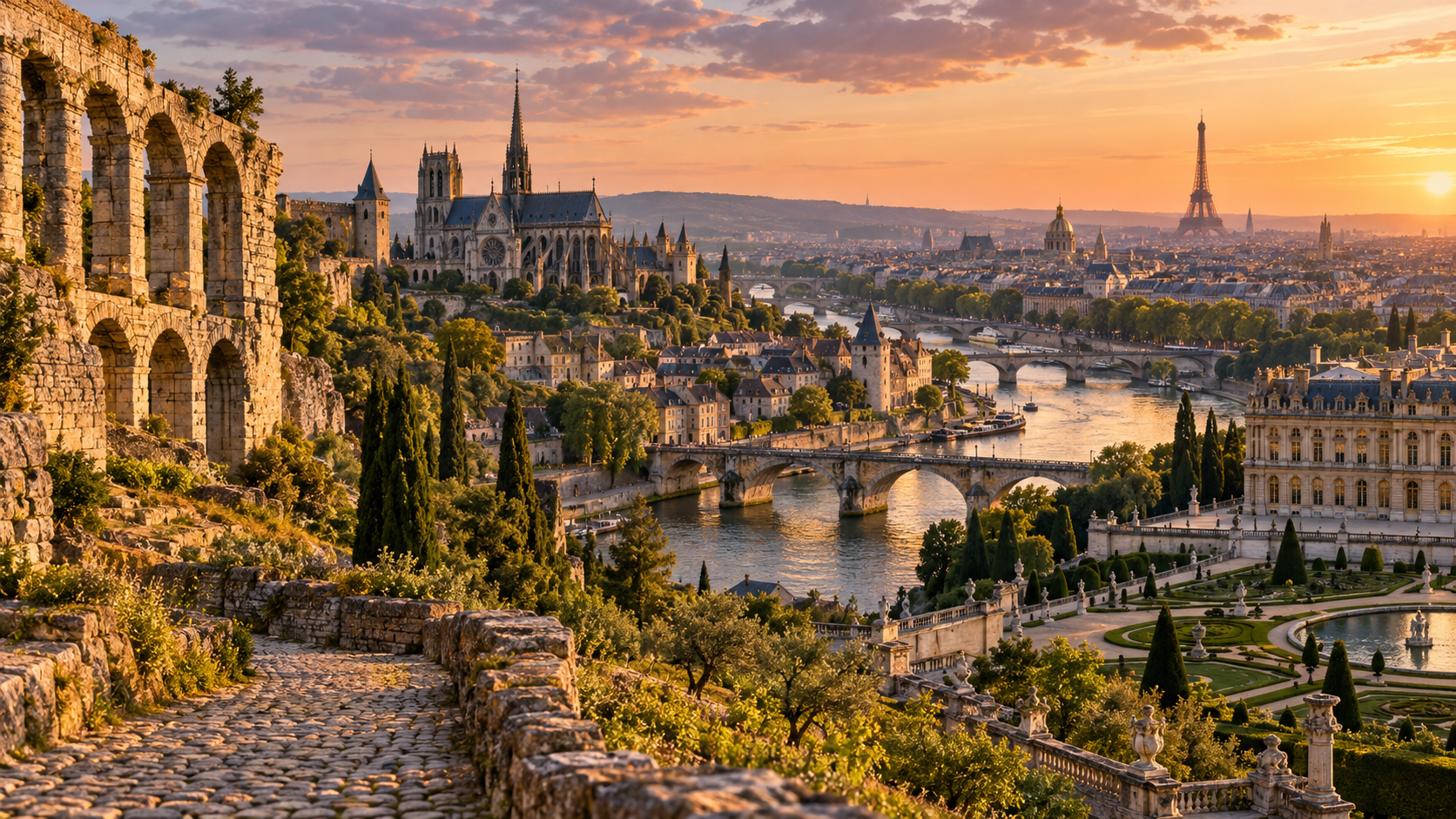
France’s History Is Still Visible Almost Everywhere
You do not need to enter a museum to encounter history in France.
Roman remains stand inside modern cities.
Medieval cathedrals dominate skylines.
Renaissance châteaux line the Loire.
Versailles preserves royal absolutism in architectural form.
Revolutionary history fills Paris.
Napoleonic monuments sit beside modern boulevards.
World War battlefields stretch across northern France.
That density is one reason traveling through France can feel like walking through overlapping time periods.
- Nîmes and the Pont du Gard show Roman France.
- Chartres and Reims represent medieval religious power.
- The Loire Valley preserves Renaissance royal culture.
- Versailles embodies the height of absolute monarchy.
- Paris contains major Revolutionary and Napoleonic sites.
- Normandy preserves key World War II landscapes.
French Food Has a History Too
French cuisine did not appear fully formed with white tablecloths and tiny portions.
Regional agriculture shaped food first.
Butter became central in Normandy and Brittany.
Olive oil dominates more strongly in Provence.
Alsace carries Germanic culinary influences.
Southwestern France developed traditions around duck, beans and preserved meats.
Wine regions built identities around local grapes and soils.
Paris later became a center of professional restaurant culture.
After the Revolution, chefs who had previously worked for aristocratic households increasingly entered public restaurant life.
Over time, French culinary techniques became internationally influential.
The French Language Is Basically a History Lesson You Speak
French developed primarily from spoken Latin in Roman Gaul.
Germanic Frankish influence added vocabulary and helped shape pronunciation.
Regional Romance languages developed differently across the country.
In northern France, varieties known collectively as langues d’oïl influenced what became standard French.
Southern France had langues d’oc, including Occitan traditions.
The monarchy and later the republic promoted a standardized national language.
That process helped unify administration but weakened many regional languages.
Modern French still carries those historical layers.
FAQ About the History of France
When did France become a country?
There is no single birthday. West Francia emerged after the Carolingian Empire was divided in 843, while the Capetian dynasty beginning in 987 is often treated as a major foundation for the medieval Kingdom of France.
Who lived in France before the Romans?
Much of ancient France was inhabited by Celtic-speaking peoples collectively called Gauls, along with other groups in border and Mediterranean regions.
When did Rome conquer France?
Julius Caesar conquered most of Gaul during campaigns between 58 and 50 BCE. The defeat of Vercingetorix at Alesia in 52 BCE was a major turning point.
Why is Charlemagne important to French history?
Charlemagne ruled a vast Frankish empire and shaped medieval European politics, education and Christianity. The western portion of his divided empire later contributed to the development of France.
When was the French Revolution?
The Revolution began in 1789. The monarchy was abolished in 1792, and the revolutionary period continued through several governments until Napoleon’s coup in 1799.
When did Napoleon rule France?
Napoleon became First Consul in 1799 and Emperor in 1804. His first reign ended in 1814, followed by a brief return during the Hundred Days in 1815.
What are the most important places for learning French history?
Paris, Versailles, Normandy, the Loire Valley, Reims, Nîmes, Avignon, Lyon and Carcassonne each represent different major periods of French history.
The History of France Is Really the Story of a Country Being Built Again and Again
France feels old because it is old.
But it has never been static.
Gaul became Roman.
Roman Gaul became a patchwork of Germanic kingdoms.
Frankish territories became medieval kingdoms.
Medieval kings spent centuries pulling powerful regions toward the crown.
The monarchy eventually became so centralized that Versailles could practically function as a stage set for power.
Then the Revolution tore that political system apart.
Napoleon rebuilt authority in another form.
Monarchies returned.
Republics returned.
An empire returned.
Then another republic.
Then occupation, liberation and constitutional rebuilding.
That cycle is why the history of france feels so dense.
Every generation inherited institutions from the previous one and then changed them.
You can see those layers almost anywhere.
A Roman arena hosts events in Nîmes.
A Gothic cathedral stands beside modern cafés.
Versailles receives millions of visitors who walk through rooms built to impress ambassadors three centuries ago.
The Arc de Triomphe still dominates traffic planned through 19th-century Paris.
Normandy beaches look peaceful while military cemeteries nearby explain why they are famous.
France is not one historical era preserved under glass.
It is a stack of them.
And that may be the easiest way to understand the country.
Do not ask which century created France.
Ask which century did not.


Leave a Reply