
Madrid gets the museums. Barcelona gets the architecture and beaches. Seville gets flamenco and orange trees.
And then there is Burgos.
For many American travelers, Burgos appears somewhere on a map between Madrid and northern Spain, usually as a place they pass through on a train.
That is a mistake.
This compact city in Castilla y León has one of Spain’s great Gothic cathedrals, medieval streets shaped by the Camino de Santiago, serious Castilian food, a surprisingly beautiful riverfront and one of Europe’s most important prehistoric archaeological sites just outside town.
Better yet, Burgos feels manageable.
You do not need three subway lines and a spreadsheet to see it.
The historic center is walkable. Many major sights sit within minutes of one another. You can spend the morning inside a cathedral, eat morcilla for lunch, follow the old pilgrim route through town and still have time for a slow walk beside the Arlanzón River before dinner.
It has history without feeling like a theme park.
And that may be its biggest advantage.
Where Is Burgos?
Burgos sits in northern Spain in the autonomous community of Castilla y León.
It lies northeast of Madrid and south of the Basque Country, making it a natural stop between central Spain and cities such as Bilbao, Vitoria-Gasteiz and San Sebastián.
The city stands on the Arlanzón River and occupies a strategic position on the historic Camino Francés, the best-known route of the Camino de Santiago.
This location shaped Burgos for centuries.
Pilgrims passed through. Merchants followed. Religious institutions grew. Hospitals, monasteries and churches appeared along the route.
The result is a city where medieval pilgrimage history is not hidden in one museum.
It is built into the street plan.
| Quick Fact | Burgos |
|---|---|
| Region | Castilla y León, Spain |
| Main river | Arlanzón |
| Best-known landmark | Burgos Cathedral |
| Major historic route | Camino de Santiago, Camino Francés |
| Nearby archaeological site | Atapuerca |
| Famous local food | Morcilla de Burgos |
| Good trip length | 1-3 days |
The Cathedral Is the Reason Many People Come – and It Deserves the Hype
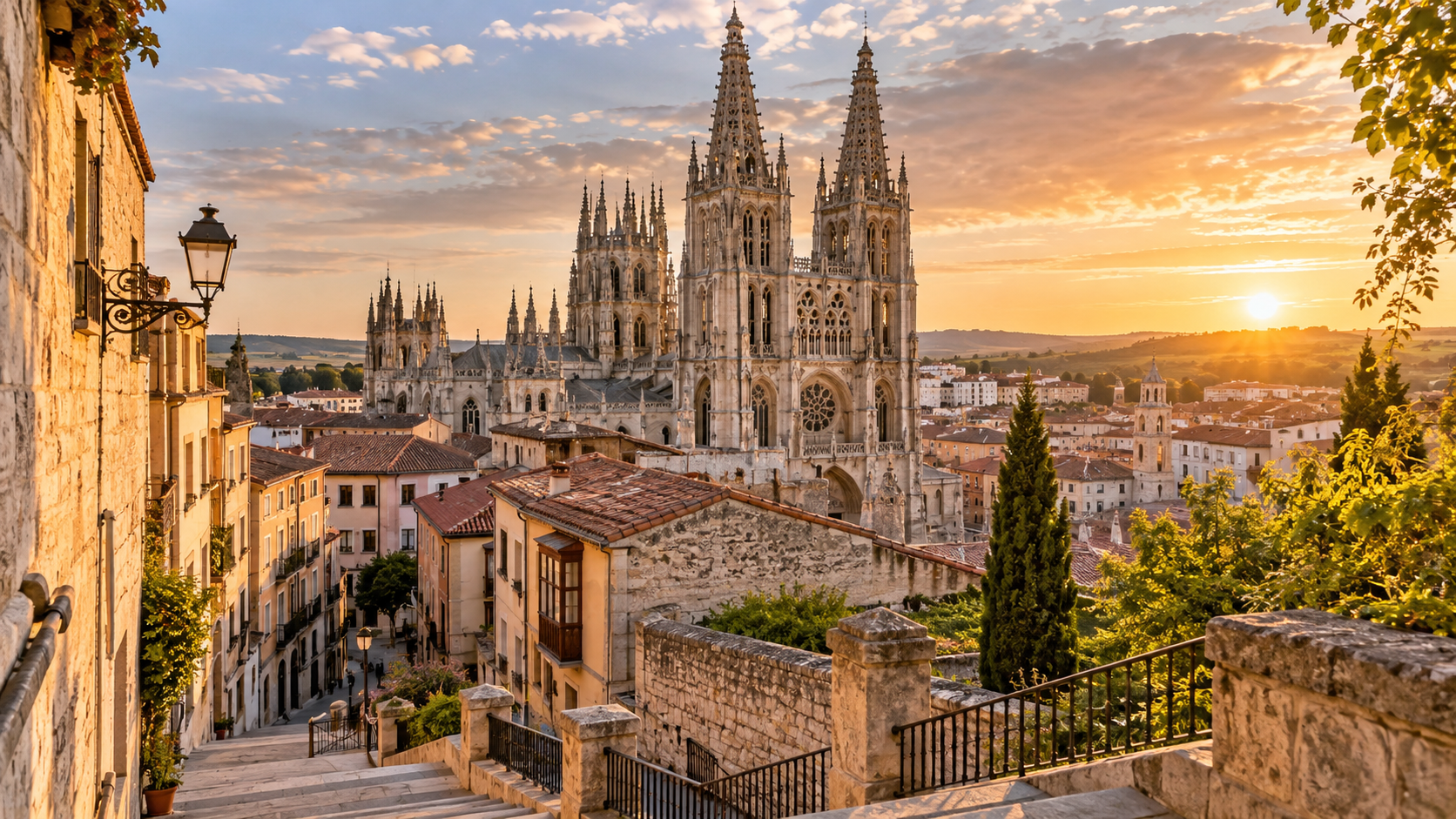
Burgos Cathedral dominates the historic center.
You notice it before you understand it.
Two elaborate towers rise above the rooftops, covered with delicate stonework that looks almost too fine to be structural. Walk around the building and the appearance changes constantly. One side feels monumental. Another looks almost lace-like.
Construction began in 1221.
The cathedral developed over several centuries, which is why it contains different phases of Gothic architecture rather than representing one frozen moment.
Later additions continued into the 15th and 16th centuries.
The building became a UNESCO World Heritage property in 1984.
And unlike some famous churches that are more impressive outside than inside, Burgos Cathedral keeps going.
Chapels open off the main spaces. Sculpted tombs appear around corners. Choir stalls, stained glass, altarpieces and decorative stonework compete for attention.
You will probably miss details.
That is normal.
Look Up at the Crossing
One of the cathedral’s most striking features is the star-shaped vaulted structure above the crossing.
It is elaborate without feeling heavy.
Light filters through openings above and gives the stone an almost weightless quality.
This is the kind of architecture that makes you stop worrying about how many chapels remain on the visitor route.
Just stand there for a minute.
The Constable’s Chapel Is Basically a Cathedral Inside the Cathedral
The Chapel of the Constables, or Capilla de los Condestables, is among the most spectacular parts of the complex.
It was built as a funerary chapel for powerful nobles in the late 15th and early 16th centuries.
The interior combines sculpture, architecture and decoration at a scale that makes the word “chapel” feel misleadingly modest.
This is one of those places where medieval wealth becomes very visible.
Religion, status and memory all occupy the same room.
El Cid Is Buried Here
Rodrigo Díaz de Vivar, better known as El Cid, is one of the great legendary figures of medieval Spain.
He was born near Burgos in the 11th century and became a military leader whose career crossed the complicated political world of Christian and Muslim Iberia.
Centuries of literature transformed him into something larger than the historical person.
The epic poem Cantar de mio Cid turned him into a national literary hero.
Today, El Cid and his wife Jimena are buried inside Burgos Cathedral.
If you know him mainly from old Hollywood movies or vague school references, Burgos suddenly gives the story a physical setting.
The Cathedral Plaza Is Best Early or Late
During the middle of the day, the square can feel busy.
Come early in the morning and the atmosphere changes.
The stone is cooler. Delivery vans have not completely disappeared, but the city has not fully woken up. Later, evening light gives the towers more texture.
If you stay overnight, walk back after dinner.
The illuminated cathedral feels very different from the daytime version.
Arco de Santa María Gives You the Classic Entrance
Approach the old center from the river and you eventually reach the Arco de Santa María.
The monumental gate looks more like a ceremonial façade than a defensive entrance.
It stands beside the river and frames the transition between the promenade and the cathedral quarter.
The current appearance dates mainly from the 16th century.
Its sculpted figures reference kings and important historical personalities linked with Castile and Burgos.
Walk through the arch and the cathedral suddenly appears ahead.
It is one of the city’s best little pieces of urban theater.
Paseo del Espolón Is Where Burgos Slows Down
The Paseo del Espolón runs beside the Arlanzón River between rows of trees and elegant buildings.
It is not a “must-see attraction” in the usual travel-guide sense.
That is why it is useful.
People walk here. Families sit on benches. Locals cross between the historic center and the river. Cafés and terraces make the area easy to linger around.
After several hours of Gothic architecture, this is where your brain gets a break.
Burgos is particularly good at these small pauses.
Plaza Mayor Is the Social Center
Burgos’ Plaza Mayor is colorful, enclosed and lively without being enormous.
Restaurants and cafés spill toward the center.
The surrounding streets lead into narrow lanes filled with bars, bakeries and small shops.
This is a useful place to reset your internal map.
Cathedral one way.
River another.
Tapas somewhere nearby.
You will figure it out.
The Camino de Santiago Runs Straight Through Burgos
This may be the most important thing to understand about the shape of the old city.
Burgos developed partly around the flow of pilgrims heading west toward Santiago de Compostela.
The historic Camino route enters the city through neighborhoods connected with medieval religious institutions and continues through the historic center.
Street names, churches and former hospitals reflect that history.
You will see pilgrims with backpacks and walking poles even if you are visiting purely as a city tourist.
Some look energetic.
Others have the facial expression of people reconsidering every footwear decision they have made.
Either way, the Camino gives Burgos a sense of movement.
Why the Camino Mattered So Much
Medieval pilgrimage was not only religious.
It also moved ideas, art, money and people.
Travelers needed accommodation, medical care and food.
Churches and monasteries emerged along routes.
Foreign artistic influences traveled with pilgrims and craftsmen.
Burgos became one of the major urban centers along the Camino Francés.
- Pilgrims created demand for hospitals and religious institutions.
- Merchants benefited from regular movement through the city.
- Architectural styles spread along the route.
- Local streets developed around the historic pilgrimage corridor.
- Burgos became connected culturally with communities across Europe.
The Camino is therefore not just an activity modern hikers rediscovered.
It helped shape the city itself.
San Lesmes Is a Good Camino Stop Even If You Are Not Walking to Santiago
The Church of San Lesmes sits along the historic pilgrim route.
It is connected with Saint Lesmes, a figure strongly associated with medieval Burgos and care for pilgrims.
The church is less visually overwhelming than the cathedral.
That is partly the appeal.
It gives you a quieter sense of the religious infrastructure that supported travelers centuries ago.
San Gil Is Easy to Miss
The Church of San Gil sits slightly away from the cathedral-centered flow.
From outside, it can appear relatively restrained.
Inside, the Gothic space and chapels are far richer than the exterior suggests.
This is a recurring Burgos lesson.
Do not judge churches only from the street.
Climb Toward Burgos Castle for the View
Above the old city lies the hill associated with Burgos Castle.
The original fortress suffered destruction and alteration across centuries, so do not expect a perfectly preserved fairy-tale castle.
The better reason to climb is the view.
From above, Burgos suddenly makes geographic sense.
The cathedral towers rise from the compact historic core.
The Arlanzón cuts across the city.
The flat Castilian landscape spreads outward.
It is also a good reminder that Burgos was historically a strategic military location, not merely a collection of pretty medieval buildings.
Bring a Jacket More Often Than You Think
Burgos sits at fairly high elevation on Spain’s northern plateau.
The climate can surprise travelers who assume “Spain” automatically means hot weather.
Winters can be cold.
Spring mornings can feel chilly.
Even summer evenings can be cooler than Madrid or southern Spain.
Locals have a reputation for joking about the cold.
You may join them surprisingly quickly.
The Museum of Human Evolution Is One of the Best Reasons to Stay an Extra Day
The Museo de la Evolución Humana, or Museum of Human Evolution, sits across the river from the old center.
Its modern architecture makes an immediate contrast with the Gothic skyline.
Inside, the subject goes much farther back than medieval Burgos.
Much, much farther.
The museum interprets discoveries from the nearby archaeological sites of Atapuerca and places them within the wider story of human evolution.
Fossils, reconstructions and archaeological evidence show how researchers piece together human history from bones, tools and sediments.
If you normally avoid museums because you fear endless display cases, this one is easier to engage with.
The story is big.
Basically: us.
Atapuerca Takes Burgos History Back Nearly a Million Years
The Sierra de Atapuerca lies east of the city.
Its cave systems contain an extraordinary archaeological and fossil record documenting ancient human presence over an enormous span of time.
The archaeological complex is recognized as a UNESCO World Heritage property.
Researchers have recovered human remains, stone tools and animal fossils that have contributed significantly to debates about early human settlement in Europe.
Some deposits reach back close to one million years.
That changes your sense of scale.
Spend the morning thinking about medieval knights.
Then realize people were living in the region hundreds of thousands of years before anything called Spain existed.
Should You Visit Atapuerca or Just the Museum?
If you have one day in Burgos, stay in the city.
The museum gives you good context without requiring extra transportation.
With two or three days, Atapuerca becomes worth considering.
Guided visits provide the most useful experience because archaeological sites rarely explain themselves visually.
A trench can look like dirt until someone tells you what archaeologists found inside it.
Then suddenly it becomes fascinating dirt.
The Monastery of Las Huelgas Is One of Burgos’ Most Important Historic Sites
The Monasterio de Santa María la Real de Las Huelgas sits west of the historic center.
Founded in the 12th century under royal patronage, it became closely connected with the Castilian monarchy.
Queens, princes and noble families were buried here.
The complex mixes architectural influences accumulated over centuries.
It is quieter than the cathedral and gives a different perspective on medieval power.
If the cathedral represents the city’s public religious grandeur, Las Huelgas feels more closely tied to dynasty, court and royal memory.
Miraflores Charterhouse Is Another Place Worth Leaving the Center For
The Cartuja de Miraflores lies a short distance outside the central tourist core.
The monastery is famous for late Gothic art and royal tombs.
Its church contains the elaborate tombs of King John II of Castile and Isabella of Portugal, parents of Isabella I of Castile.
The sculptural detail is extraordinary.
And because it sits outside the busiest center, the atmosphere tends to feel calmer.
El Cid Is Everywhere Once You Start Looking
Burgos has leaned into its association with El Cid.
You will find statues, street references and historical sites connected with his story.
A large equestrian monument stands prominently in the city.
His historical identity is more complicated than the straightforward Christian warrior image later legend created.
Medieval Iberia involved shifting alliances between Christian and Muslim rulers, and El Cid served different political masters during his career.
That messy reality is more interesting than the simplified myth.
Now We Need to Talk About Morcilla
Burgos is famous for morcilla de Burgos.
Yes, blood sausage.
Stay with me.
The Burgos version commonly combines pork blood with rice, onion and spices. It is often sliced and fried, giving the outside a crisp texture while the interior remains soft.
The rice distinguishes it from several other Spanish blood sausages.
If you already know you dislike blood sausage, nobody needs to stage an intervention.
But if you are simply nervous about the idea, Burgos is probably the place to try it.
Lechazo Is the Other Big Castilian Classic
Lechazo refers to very young lamb traditionally roasted in a wood-fired oven.
Good versions are remarkably simple.
Lamb, heat, salt, maybe water.
The point is the meat rather than a complicated sauce.
This style of cooking is strongly associated with Castilla y León.
It is richer and heavier than coastal Spanish food.
Which makes sense.
This is inland plateau food developed for a cooler climate.
What Else Should You Eat in Burgos?
- Try morcilla de Burgos fried in thick slices or served in tapas.
- Order lechazo if you want a full traditional Castilian meal.
- Look for local cheeses and cured meats.
- Try olla podrida, a hearty regional stew, when available.
- Drink wines from nearby Ribera del Duero or Arlanza.
- Leave room for pastries because Spanish bakeries are very good at ruining sensible meal plans.
This is not a destination where lunch needs to be light.
Ribera del Duero Is Close Enough to Matter
South of Burgos city lies part of the famous Ribera del Duero wine region.
The area is known mainly for red wines based on Tempranillo, locally often called Tinta del País or Tinto Fino.
If wine is a major reason for your Spain trip, Burgos can work as part of a broader Castilian route combining historic towns and vineyards.
Aranda de Duero is one of the best-known towns in the region.
Do not plan a serious wine day and then confidently announce that you will drive afterward.
Some traditions are better with transportation arranged.
Burgos Is a Good City for Tapas Without Overthinking It
You do not need a famous restaurant reservation every night.
Walk the streets around the historic center and stop where locals are actually eating.
Order one or two things.
Have a drink.
Move somewhere else.
That style works particularly well in a compact city.
American visitors sometimes turn tapas into an organized dining mission.
It does not need to be that serious.
Half the point is wandering.
One Day in Burgos: The Efficient Version
If you only have a day, you can still see the essentials without turning the visit into a race.
- Start early at Burgos Cathedral.
- Walk through the historic streets and Plaza Mayor.
- Cross through the Arco de Santa María and stroll along Paseo del Espolón.
- Have a traditional lunch with morcilla or another Castilian dish.
- Spend the afternoon at the Museum of Human Evolution.
- Climb toward the castle viewpoint before sunset.
- Return to the cathedral area for tapas in the evening.
That gives you medieval Burgos, prehistoric Burgos and edible Burgos in one day.
Pretty efficient.
Two Days Lets the City Make More Sense
With a second day, add Las Huelgas and the Cartuja de Miraflores.
You can also walk more of the Camino route through the city rather than jumping between landmarks.
That slower pace matters.
Burgos is not really a checklist city.
The best parts are often transitions.
A narrow street between churches.
A river crossing.
A bar you enter because it smells good.
A group of pilgrims passing beneath an arch.
Three Days Gives You Time for Atapuerca
If archaeology interests you, use the third day for Atapuerca.
Combine the archaeological visit with the Museum of Human Evolution either before or afterward.
Seeing both creates a much stronger picture than treating them as separate attractions.
| Trip Length | What to Prioritize | Good Add-On |
|---|---|---|
| 1 day | Cathedral, old town, river, Human Evolution Museum | Castle viewpoint |
| 2 days | All major city sights | Las Huelgas and Miraflores |
| 3 days | City plus nearby heritage | Atapuerca |
| 4+ days | Regional exploration | Ribera del Duero or Camino villages |
How to Get to Burgos From Madrid
Rail is generally the easiest option for most visitors.
Burgos is connected with Madrid by long-distance and high-speed services, and the fastest scheduled journeys can take roughly an hour and a half.
The city’s railway station is Burgos Rosa Manzano.
It is not directly inside the medieval center, so you will need local transportation between the station and your hotel or sights.
Buses also connect Burgos with Madrid and other Spanish cities.
A rental car becomes more useful if Burgos is part of a broader trip through northern Castilla y León, Atapuerca, wine country or smaller villages.
Burgos Also Fits Nicely Into a Northern Spain Route
One advantage of Burgos is location.
You can combine it naturally with several very different destinations.
Head north toward Bilbao for contemporary architecture and Basque food.
Go northeast toward La Rioja for wine.
Continue west along the Camino toward León.
Travel south toward Valladolid and Ribera del Duero.
Return to Madrid by train.
Burgos works as a bridge between regions rather than an awkward detour.
What Is the Best Time to Visit Burgos?
Late spring and early fall are easy choices.
Days are generally comfortable for walking and the city avoids some of the most extreme temperatures.
Summer can be warm during the day, but nights may still cool down.
Winter brings genuine cold.
Not cute “Spanish winter” cold.
Actual coat weather.
Snow is possible.
If you visit in winter, the upside is atmosphere and fewer tourists.
Just bring proper layers.
Is Burgos Expensive?
Compared with Madrid, Barcelona or high-demand coastal destinations, Burgos can feel relatively reasonable.
Hotels, cafés and restaurants often offer better value than Spain’s biggest tourist centers.
That does not mean everything is cheap.
But your budget tends to stretch farther.
You are also less likely to spend twenty minutes deciding whether a restaurant exists mainly to serve tourists.
Do You Need a Car?
Not for the city.
The historic core is compact and walking is part of the experience.
A car can actually become inconvenient around narrow streets and parking zones.
You may want one for Atapuerca, wine country or smaller villages, depending on your plans.
For a one- or two-day city break, skip it.
Why Burgos Feels Different From Southern Spain
Travelers who arrive after Seville, Málaga or Granada sometimes experience a tiny cultural temperature shock.
The landscape is different.
The climate is different.
The architecture feels heavier.
The food is more focused on meat, stews and inland ingredients.
Castilla has a broader, quieter landscape.
There are fewer palm trees doing publicity work.
That difference is useful.
Spain makes more sense once you stop imagining it as one climate and one culture.
Is Burgos Worth Visiting if You Are Not Religious?
Absolutely.
The cathedral is important architecturally whether or not you are Catholic.
The Camino is interesting as social and European history even if pilgrimage does not appeal to you spiritually.
Atapuerca has nothing to do with medieval Christianity.
The Human Evolution Museum reaches far beyond local history.
And food remains beautifully non-denominational.
A Few Small Things Make a Burgos Trip Better
- Bring a light jacket even when the forecast looks mild.
- Book cathedral time early in the day if you prefer quieter visits.
- Walk instead of taking taxis inside the historic core.
- Do not schedule every meal in advance; Burgos works well for spontaneous tapas stops.
- Give the Human Evolution Museum more time than you think you need.
- If visiting Atapuerca, check tour arrangements before your trip rather than arriving randomly.
The city is easy.
Do not make it complicated.
FAQ About Burgos
What is Burgos famous for?
Burgos is best known for its UNESCO-listed Gothic cathedral, its connection with El Cid, its place on the Camino de Santiago, the nearby Atapuerca archaeological sites and regional foods such as morcilla de Burgos.
Is Burgos worth visiting?
Yes. It is especially worthwhile for travelers interested in architecture, Spanish history, archaeology, food and the Camino de Santiago. The compact center also makes it an easy one- or two-day stop.
How many days do you need in Burgos?
One day covers the major city highlights. Two days feels more relaxed and allows time for monasteries and museums. Three days is ideal if you want to add Atapuerca.
Is Burgos Cathedral a UNESCO World Heritage Site?
Yes. Burgos Cathedral has been inscribed on the UNESCO World Heritage List since 1984 and is regarded as an outstanding example of Gothic architecture.
What should you eat in Burgos?
Morcilla de Burgos and roast lechazo are the two classic dishes. Local cheeses, cured meats, Castilian stews and wines from nearby regions are also worth trying.
Can you visit Burgos as a day trip from Madrid?
Yes. Fast rail connections make a day trip possible, with some journeys taking roughly an hour and a half each way. Staying one night is better if you want to see the city after the daytime crowds leave.
What is Atapuerca and why is it important?
Atapuerca is a major archaeological complex near Burgos containing an exceptional fossil record of ancient human occupation in Europe. Its discoveries span hundreds of thousands of years and have contributed greatly to research on human evolution.
Burgos Is Better When You Do Not Expect Too Much From It
That sounds like an insult.
It is actually a compliment.
Burgos does not arrive with the pressure of Paris, Rome or Barcelona.
You are not running between globally famous attractions while wondering whether you are appreciating them correctly.
You can simply walk.
The cathedral appears at the end of a street.
A pilgrim crosses the square.
You stop for coffee.
The river catches the afternoon light.
You try morcilla and discover you either love it or absolutely do not.
Both outcomes make a story.
Then you walk into a museum and suddenly the timeline shifts from medieval kings to ancient humans living in the region nearly a million years ago.
That range is what makes Burgos surprisingly good.
It gives you several versions of Spain in one compact place.
Prehistoric Iberia at Atapuerca.
Medieval Castile in the cathedral and monasteries.
The Camino de Santiago running through city streets.
El Cid’s legend sitting beside actual history.
Modern Spanish life unfolding around all of it.
And because Burgos is not overloaded with bucket-list expectations, you have time to notice smaller details.
Stone balconies.
Cold morning air.
Old churches squeezed into side streets.
People taking an evening walk beside the Arlanzón.
Pilgrims checking their phones under buildings constructed centuries before electricity existed.
That mix feels natural here.
So yes, visit the cathedral.
It is extraordinary.
But do not leave immediately afterward.
Walk the Camino route through town.
Cross the river.
Spend time with Atapuerca’s story.
Eat something unmistakably Castilian.
Climb above the rooftops before sunset.
And give Burgos at least one evening.
It is exactly the sort of city that gets more interesting after you stop treating it as a stopover.

Leave a Reply